Speed and torque depend on your supply voltage
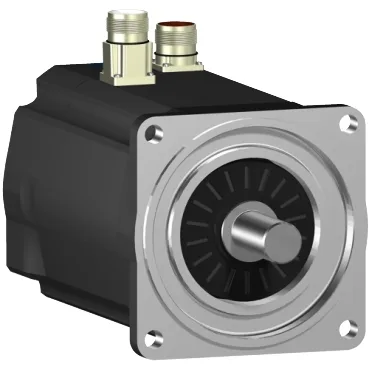
The SH31402P02A1000: This SH3 servo motor delivers very different performance depending on what voltage you feed it. At 480 V three-phase, it spins 3600 rpm with 85.9 lbf.in (9.7 N.m) nominal torque. Drop to 115 V single-phase and you get 750 rpm at 164.6 lbf.in (18.6 N.m). The nominal output power ranges from 1460 W at 115 V single-phase up to 3860 W at 400 V three-phase. Match the line voltage to the performance column in the datasheet before committing the BOM line. The motor is wound for three-phase operation, but the torque/speed table shows it runs on single-phase supply at reduced output. The 44.1 A maximum current (Irms) and 13.2 A continuous stall current give the drive sizing boundary for the continuous thermal limit.
Encoder feedback — Hiperface protocol, not generic SinCos
The absolute multiturn SinCos Hiperface encoder is a specific feedback protocol. Your drive must support Hiperface — not just any SinCos interface. This is standard on Lexium 32 and PacDrive 3 systems. The multiturn absolute count means the motor knows its position on power-up without a homing cycle, as long as the battery-backed encoder memory is intact.
IP rating and shaft seal — washdown capable with the right option
The motor body is IP65 per IEC 60034-5. The shaft bushing is IP54 without the shaft seal ring, and IP65 with it fitted. If this motor goes into a washdown zone, make sure the shaft seal ring is installed — otherwise moisture can ingress through the bushing. The smooth shaft means no keyway to trap debris, but also no positive drive engagement — the coupling or pulley must use a clamping method.