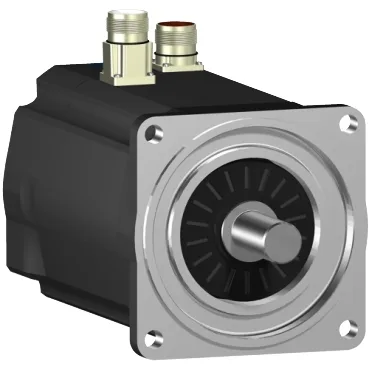
Speed and torque depend on supply voltage
The SH31403P01A1200: This motor delivers 3000 rpm at 400 V three-phase input, but the same motor reaches 3600 rpm on 480 V three-phase and only 750 rpm on 115 V single-phase. The nominal torque follows the same pattern: 12.9 N·m at 400 V three-phase, 9.1 N·m at 480 V three-phase, and 24.7 N·m at 115 V single-phase. The peak stall torque holds at 90.2 N·m across the 115–480 V three-phase range. Continuous power output is 4050 W at 400 V three-phase, dropping to 1940 W on 115 V single-phase. The 4100 W continuous power rating applies to the three-phase configuration.
Encoder feedback and environmental sealing
The absolute single-turn SinCos Hiperface encoder provides position feedback without needing a homing cycle on power-up — the single-turn resolution covers one mechanical revolution. This mates directly with Schneider's Lexium servo drives that support the Hiperface protocol. IP65 on the motor body and shaft bushing, IP67 on the housing per IEC 60034-5. The smooth shaft (no keyway) and straight connector simplify washdown-area integration but require a clamping coupling for torque transmission.
Mounting and mechanical interface
International standard flange, 140 mm flange size, 130 mm centring collar diameter, 3.5 mm centring collar depth. Four mounting holes on an 11 mm diameter bolt circle. The 24 mm smooth shaft extends 50 mm from the face. Maximum radial force at the shaft is 2420 N at 1000 rpm, derating to 1670 N at 3000 rpm. Maximum axial force is 300 N. Maximum mechanical speed is 4000 rpm — do not exceed this regardless of electrical supply frequency.
Electrical parameters for drive tuning
Stator resistance 0.4 Ω, stator inductance 7.72 mH, back EMF constant 105 V/krpm at 20°C. Torque constant 1.58 N·m/A at 120°C copper temperature. Continuous stall current 17.6 A, maximum RMS current 61 A. These values feed directly into the servo drive's autotuning routine for current loop and velocity loop gains.