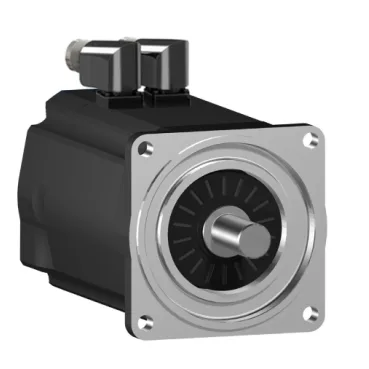
Application fit — what this SH3 motor with brake is for
The SH31403P12F2200 is a Schneider Electric SH3 series servo motor with an integrated holding brake, sized for applications that need to hold a vertical or high-inertia load at standstill without power. The 140 mm flange (5.5 in) and 4.1 kW continuous power rating place it in the mid-to-high torque range of the SH3 family, suited for packaging, material handling, and machine tool axes where the load demands a brake for safety or position retention. The motor is three-phase, with a speed range that depends on the supply voltage: 750 rpm at 115 V single phase, 1500 rpm at 230 V single phase, 3000 rpm at 400 V three phase, and 3600 rpm at 480 V three phase. This voltage-dependent speed profile means the drive selection must match the available line voltage to hit the target axis speed.
Torque delivery and the brake — what the numbers mean for the axis
Nominal torque varies significantly with supply voltage and phase configuration: 24.7 N·m at 115 V single phase, 21.2 N·m at 230 V single phase, 12.9 N·m at 400 V three phase, and 9.1 N·m at 480 V three phase. The continuous stall torque across the three-phase range is 27.8 N·m, and the peak stall torque reaches 90.2 N·m — this is the torque available for acceleration and deceleration transients before the drive current limit (61 A RMS) intervenes. The holding brake delivers 36 N·m of static torque, which is higher than the continuous stall torque at any voltage configuration. This means the brake can hold the load at standstill even if the motor is at its thermal limit — a critical margin for vertical-axis applications where a brake failure drops the load.
Environmental sealing and mechanical limits
The motor body carries IP65 protection per IEC 60034-5, with the shaft bushing also rated IP65 and the housing IP67. The rotatable right-angled connector lets the cable exit in the direction that best fits the cable tray or track. The motor mounts on an international standard flange (140 mm), with a centring collar depth of 3.5 mm and mounting holes at 11 mm diameter. The shaft is 24 mm diameter with a parallel key, 50 mm shaft length, and 8 mm key width. Maximum radial force at the shaft is 2420 N at 1000 rpm, derating to 1670 N at 3000 rpm; maximum axial force is 300 N. These limits define the allowable belt tension or direct-coupling overhung load. Cooling is by natural convection — no external fan or forced air. The continuous power rating of 4100 W assumes free airflow around the motor body; mounting in a confined space or against a panel face will require derating or supplementary cooling.
Encoder and electrical interface — what the drive needs to know
The encoder is an absolute multiturn SinCos Hiperface type — this is a digital-plus-analog interface that provides position feedback over multiple shaft revolutions without a battery backup. The drive must support Hiperface protocol; common Schneider-compatible drives include the Lexium 32 and Lexium 62 series. Stator resistance is 0.4 Ω and stator inductance is 2.66 mH, which the drive's auto-tuning routine uses to set current regulator gains. The motor has 5 poles and a maximum RMS current of 61 A (also the 3-second peak current). The nominal output power at 400 V three phase is 4050 W, close to the continuous power rating of 4100 W — the motor is thermally limited, not current-limited, at this voltage.