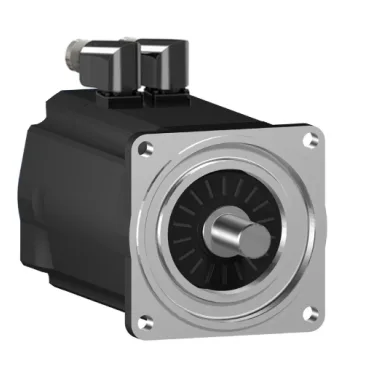
4040 W continuous power — thermal capability for continuous duty
The SH31404P01A2200: Rated 4040 W continuous power at 400 V three-phase — this is the thermal limit the motor can sustain without exceeding the 130 °C copper hot-spot temperature. The nominal torque at that same voltage is 12.9 N.m at 3000 rpm, so the power equation holds: torque (N.m) × speed (rad/s) = output power. For applications needing sustained high-speed machining or winding, this rating governs the duty cycle.
Speed-torque curves by supply voltage — match to your line
Nominal speed and torque both shift with the supply: at 115 V single-phase, the motor delivers 750 rpm and 30.2 N.m; at 230 V single-phase, 1500 rpm and 26.3 N.m; at 400 V three-phase, 3000 rpm and 12.9 N.m; at 480 V three-phase, 3600 rpm and 11.1 N.m. The peak stall torque is 131.9 N.m across the 115-480 V three-phase range — that's the short-term overload for acceleration or clearing a jam. The maximum mechanical speed of 4000 rpm means you cannot overspeed beyond that, even at 480 V.
Encoder and feedback — absolute single-turn SinCos Hiperface
Fitted with an absolute single-turn SinCos Hiperface encoder. Single-turn means absolute position within one revolution — no homing sequence needed on power-up if the application stays within a single turn. The SinCos sinusoidal signals give high-resolution interpolation for smooth low-speed control. This encoder type mates directly with Schneider's Lexium servo drives and many third-party drives that support Hiperface protocol.
Sealing and environment — IP65 motor, IP67 housing
The motor body meets IP65 per IEC 60034-5, the shaft bushing is IP65, and the housing is IP67. But note: the shaft bushing is only IP65, so a direct high-pressure jet on the shaft seal could breach it; a shaft seal guard or boot is worth considering if the washdown pressure exceeds 30 bar.
No holding brake — plan for external hold
This variant ships without a holding brake. For vertical-axis applications (e.g., a lifting spindle or Z-axis on a gantry), the load will drop when the drive is de-energized unless an external brake is added — either a spring-set brake on the motor shaft or a brake resistor in the drive to hold the load via the servo loop. The continuous stall torque of 33.4 N.m across the three-phase range gives the motor holding capability at zero speed, but that requires the drive to remain powered and in torque-control mode.
Mounting and mechanical interface
Flange size is 140 mm (5.5 in) with an international standard flange pattern — four mounting holes on a 130 mm centring collar, hole diameter 11 mm. The shaft is 24 mm diameter, 50 mm long, smooth (no keyway). The centring collar depth is 3.5 mm, so the mating pilot bore must be at least that deep for proper alignment. The rotatable right-angled connector allows cable exit in tight enclosures — the connector body can be rotated to point the cable in the best direction before tightening.