Speed-torque envelope across supply voltages
The SH31404P01F1000: This motor's performance changes significantly with the supply voltage feeding the drive. At 400 V three-phase, nominal speed is 3000 rpm with 4040 W continuous output and 12.9 N·m nominal torque. On 480 V three-phase, speed climbs to 3600 rpm and output to 4190 W, while torque drops slightly to 11.1 N·m. Single-phase supply limits both speed and power: 750 rpm / 2370 W at 115 V, and 1500 rpm / 4130 W at 230 V. The motor is wound for three-phase drive output — single-phase operation depends on the drive's input stage, not the motor windings.
Brake and torque capacity for vertical-axis loads
The integrated holding brake delivers 36 N·m static holding torque — enough to secure a vertical-axis load without a separate mechanical brake. Peak stall torque reaches 131.9 N·m across the 115–480 V three-phase range, giving headroom for acceleration transients during direction changes.
Feedback and environmental sealing
The absolute single-turn SinCos Hiperface encoder provides position feedback without a home sequence on power-up — the drive reads the absolute position within one revolution. Single-turn means the encoder tracks position within one shaft rotation; multi-turn applications need a separate multi-turn encoder or a homing routine. IP65 protection is achieved when the shaft seal ring is fitted per IEC 60034-5. Without the seal ring, the shaft bushing drops to IP54. The motor body itself is IP65 rated, so washdown environments are acceptable as long as the shaft seal is installed.
Mounting dimensions and mechanical interface
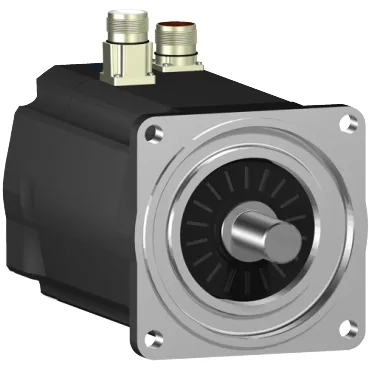
The motor flange is 140 mm (5.5 in) with a 130 mm centring collar that seats into the mating surface. Centring collar depth is 3.5 mm — the pilot diameter and depth must match the gearbox or machine interface. Four mounting holes at 11 mm diameter on the flange pattern. The smooth shaft is 24 mm diameter with a 50 mm shaft length. Maximum radial force at the shaft is 2660 N at 1000 rpm, derating to 1840 N at 3000 rpm. Maximum axial force is 300 N. These limits govern coupling selection and overhung load capacity.
Electrical constants for drive tuning
Torque constant is 1.57 N·m/A at 120 °C copper temperature — the motor produces 1.57 N·m per amp of current when hot. Back EMF constant is 104 V/krpm at 20 °C, rising with temperature. Stator resistance is 0.28 Ω and inductance is 5.945 mH, giving the electrical time constant the drive's current loop must handle. Maximum RMS current is 95.6 A, with a 3-second peak current of the same value. The continuous stall current is 21.3 A — the drive must supply at least this continuously to hold position at zero speed. Natural convection cooling means no external fan; the motor relies on its surface area and mounting plate for heat dissipation.