Speed-torque envelope by supply voltage
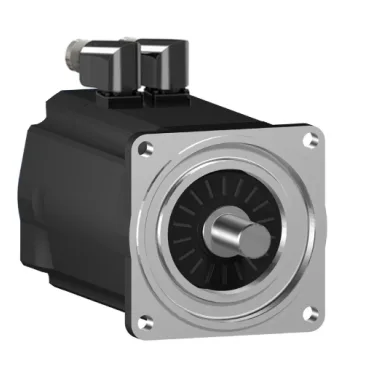
The SH31404P02A2200: This SH3 frame servo motor delivers a nominal speed that depends on the supply: 750 rpm at 115 V single phase, 1500 rpm at 230 V single phase, 3000 rpm at 400 V three phase, and 3600 rpm at 480 V three phase. The nominal torque follows the same pattern — 267.3 lbf.in (30.2 N.m) at 115 V single phase, stepping down to 98.2 lbf.in (11.1 N.m) at 480 V three phase. That means the motor's usable torque drops as line voltage rises, which is the opposite of what you'd expect from a constant-torque machine; the winding design is optimized for the lower-voltage, higher-torque corner. Continuous power is 4040 W at 400 V three phase, with 2370 W at 115 V single phase and 4190 W at 480 V three phase. The peak stall torque reaches 1167.4 lbf.in (131.9 N.m) across the 115...480 V three-phase range, while continuous stall torque is 295.6 lbf.in (33.4 N.m). Maximum mechanical speed is 4000 rpm — the winding saturates before the bearings give out.
Encoder and feedback — absolute multiturn Hiperface
The encoder is an absolute multiturn SinCos Hiperface type. This gives single-turn resolution plus 4096 multiturn counts, so the drive knows the rotor position at power-up without a homing cycle. The SinCos analog track provides interpolated position for smooth low-speed control — useful for applications that need tight velocity ripple at crawl speeds, like indexing tables or web tension sections. No holding brake is fitted on this variant (: Without). If the application requires a brake for vertical-axis holding or emergency stop, the mating drive must handle the external brake control, or a different SH3 variant with an integrated brake should be selected. The smooth shaft means no keyway — the coupling or pulley clamps directly onto the 24 mm diameter shaft with a 50 mm shaft length.
Mounting and environmental sealing
IP65 on the motor body and shaft bushing, IP67 on the housing per IEC 60034-5. The rotatable right-angled connector lets the cable exit orient to the panel layout — useful when the motor is mounted in a tight space where a straight connector would hit a beam or adjacent machine frame. Natural convection cooling means no fan — the motor relies on surface area and the machine's ambient airflow, so derate if mounted in a still-air pocket or enclosed cavity.
Electrical parameters and drive matching
Stator resistance is 0.28 Ohm and stator inductance is 5.945 mH. The torque constant is 1.57 N.m/A at 248 °F (120 °C) copper hot, and the back EMF constant is 104 V/krpm at 68 °F (20 °C). Maximum continuous current is 21.3 A, with a peak Irms of 95.6 A — the drive must be sized to supply that peak current for acceleration and deceleration without hitting its current limit. The 5-pole motor has a different commutation pattern than a standard 4-pole; the drive's motor parameter set must be configured for 5 poles, or the torque ripple will be audible. Maximum radial force Fr is 2660 N at 1000 rpm, dropping to 1840 N at 3000 rpm. Maximum axial force Fa is 300 N. These limits govern the belt tension or coupling selection — exceeding them shortens bearing life or causes shaft deflection that damages the encoder.