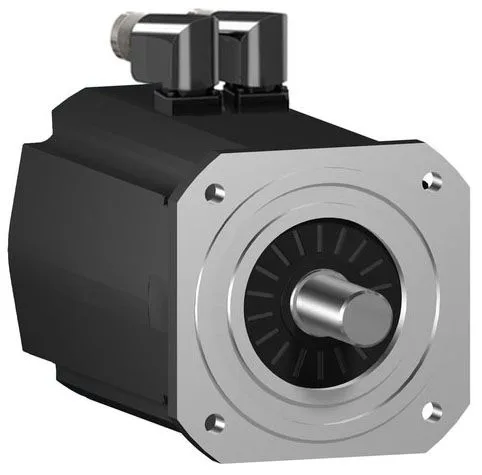
The SH32051P12A2100 is a SH3-series three-phase servo motor rated 5500 W continuous at 400 V three phase, with a nominal torque envelope that follows the voltage tap: 31.9 N.m at 115 V single phase, 27 N.m at 230 V single phase, 17.5 N.m at 400 V three phase, and 13.8 N.m at 480 V three phase. On the 400 V three-phase rail — the operating point the drive sizing should anchor against — the motor delivers 5.5 kW with 17.5 N.m of continuous torque, which is the figure to use when matching the drive's continuous current to the mechanical load. Peak stall torque reaches 110 N.m across the full 115 to 480 V range, with a continuous stall of 36.9 N.m and an Irms peak of 87.2 A — the burst margin that determines whether the drive can accelerate the load through the worst-case cycle step without tripping on I²t.
Speed points that define the drive profile
Nominal speed is voltage-tapped rather than field-weakened: 750 rpm at 115 V single phase, 1500 rpm at 230 V single phase, 3000 rpm at 400 V three phase, and 3600 rpm at 480 V three phase. In practice that means the same motor swings from 750 rpm to 3600 rpm simply by changing the supply rail — sizing the gear reducer and the drive's voltage class together is the real engineering decision, not picking a motor part number. Back-EMF constant is 104 V/krpm at 20 °C and torque constant is 1.75 N.m/A at 120 °C winding temperature; combined with stator resistance 0.3 Ohm and inductance 2.97 mH, these are the constants the drive's auto-tuning routine uses to lock the current loop to the rotor.
Mechanical envelope: 205 mm flange, 38 mm shaft
The motor mounts on an international standard flange with a 205 mm flange size, 180 mm centring collar, 14 mm mounting holes, and a 38 mm shaft diameter with an 80 mm shaft length and a 10 mm parallel key. Overall length is 321 mm — that's the dimension to budget against the machine frame when the motor drops into a replacement cut-out. Shaft loading is rated at 740 N maximum axial force and 3730 N radial at 1000 rpm, derating to 2580 N at 3000 rpm — the radial figure is the one that decides whether a belt drive, a pinion, or a direct coupling is the right coupling choice for the application.
Feedback, sealing, and the field-side wiring
Ingress is IP65 on both the motor body and the shaft bushing to IEC 60034-5; cooling is natural convection, no fan — meaning the thermal budget depends entirely on the mounting surface and any forced airflow the enclosure provides, and IP65 is enough for washdown-adjacent panels but not for direct spray zones.