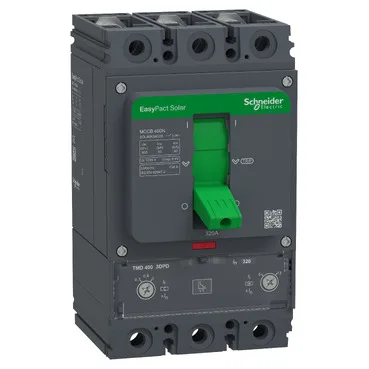
The 'L' function handles overload protection via a thermal bimetal; the 'I' function handles short-circuit protection via a magnetic solenoid. It's a Category A breaker (no intentional short-time delay), so it trips instantaneously on fault — straightforward distribution protection, not selective coordination downstream. The breaking capacity hits 50 kA at 800 V AC — that's the N performance level. It's a fixed-mount breaker with front-front connections (both line and load terminals on the front face) using screw terminals. IP20 finger-safe on the front, but the terminals are live when the breaker's on; panel builders need a separate door or cover for full protection.
It's part of the EasyPact Solar range, which is Schneider's line for photovoltaic and general distribution applications. The TM-D trip unit is the standard thermal-magnetic block — no electronic adjustments, no interchangeable trip units. What you see on the nameplate is what you get: 320 A fixed, LI protection only. If the application needs ground-fault or electronic trip curves, you'd be looking at a different family (Compact NSX or EasyPact CVS with Micrologic trip units).
If the panel runs hotter — say 50 °C — the breaker must be derated per the manufacturer's thermal curve (not provided in this listing, but standard for thermal-magnetic breakers). The 26 W power dissipation per pole means the three poles together dump about 78 W into the enclosure; factor that into panel cooling calculations, especially in a sealed box. Electrical durability is 4000 cycles at rated current and voltage — that's typical for a distribution breaker not meant for frequent switching. If the breaker will be used as a disconnect that gets cycled daily, those numbers set the replacement interval. Operating altitude: 0–2000 m no derating, 2000–5000 m with derating. Storage temperature range is -35 to 85 °C — that's the handling/storage limit, not the running ambient. The overvoltage category is III (distribution level), so it's designed for fixed installations downstream of the main service entrance.