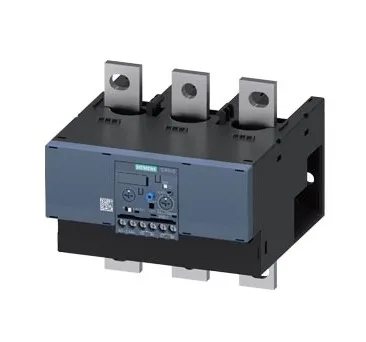
The Siemens SIRIUS 3RB2163-4GC2 is a solid-state overload relay — an electronic motor protection device that monitors current and trips on overload, phase imbalance, or phase loss. It replaces the bimetal strip with a microprocessor-based trip curve, giving you repeatable, temperature-compensated protection shot after shot. Rated thermal current is 250 A, and the trip class is field-adjustable among CLASS 5E, 10E, 20E, and 30E — so you can match the relay to the motor's starting profile: fast trip for pumps, slower for high-inertia loads like fans or centrifuges. The operating frequency is 50 to 60 Hz, covering standard line frequencies worldwide. Mounting is flexible: the relay snaps onto a SIRIUS contactor (sizes S10, S12) or can be installed standalone on a panel or DIN rail. The 120 mm width and 119 mm height fit standard SIRIUS panel layouts — no surprises when you're laying out a control cabinet.
Trip logic and signaling
The relay trips when motor current exceeds the upper setting value by a factor of 3.5, and resets when current drops below the lower setting value. The auxiliary switch is integrated and provides a dedicated "tripped" signal contact — useful for feeding a PLC input or a panel indicator so the line operator knows exactly why the motor stopped. Switching capacity of the auxiliary contact varies by voltage: 4 A at 120 V, 3 A at 230 V, 2 A at 24 V, and lower ratings at 60 V, 110 V, 125 V, and 220 V. That covers most control-circuit voltages you'll find in a panel — just verify the contact rating against your PLC input or relay coil draw.
The relay is temperature-compensated across the operating range, so the trip curve doesn't drift when the panel heats up in summer. Vibration resistance is 1-6 Hz at 15 mm amplitude, then 6-500 Hz at 20 m/s² for 10 cycles; shock resistance is 15g for 11 ms. That's enough for most industrial environments — conveyors, pumps, compressors, machine tools. Wiring: main circuit connections accept busbar connection or solid/stranded wire — 1x (0.5 to 4 mm²) or 2x (0.5 to 2.5 mm²) per terminal. The main contact tightening torque is M10.