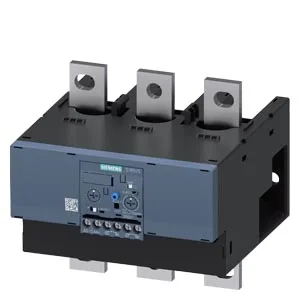
The Siemens SIRIUS 3RB2163-4MC2 is a solid-state overload relay sized for motor protection up to 630 A rated thermal current, with a maximum operating voltage of 1 000 V. The electronic overload release means no bimetal drift over time — trip accuracy stays consistent across the operating range. Adjustable trip classes 5E, 10E, 20E, and 30E let you match the relay to the motor's starting profile: a 5E setting trips fast for short-start pumps or compressors, while 30E accommodates high-inertia loads like centrifuges or large fans without nuisance tripping during start-up. The 630 A rating holds at both 480 V and 600 V, so it covers common North American and IEC voltage levels without derating. Operating frequency is 50... 60 Hz, covering standard line frequencies worldwide.
Mounts directly onto a contactor or as a standalone unit in any position — no orientation restrictions. Fastening method is contactor mounting or standalone installation, with busbar connection for the main current circuit. Dimensions are 120 mm wide, 119 mm high, 155 mm deep — fits standard S10 and S12 overload relay footprints. Wiring accepts 1x (0.5... 4 mm²) or 2x (0.5... 2.5 mm²) solid or stranded conductors on the auxiliary terminals. Shock resistance is 15g / 11 ms for the main body; the signaling contact in tripped position withstands 8g / 11 ms. Vibration resistance covers 1-6 Hz at 15 mm amplitude and 6-500 Hz at 20 m/s² over 10 cycles — robust enough for motor-starter panels on pumps or conveyors.
What the 'tripped' note means for diagnostics
The part carries a note "for message 'tripped'" — this refers to the signaling contact that changes state when the relay trips. The auxiliary switch is designed to output a clear 'tripped' signal back to the PLC or annunciator, so a maintenance technician can identify which motor in a bank has faulted without opening the panel. Contact ratings vary by voltage: 4 A at 120 V, 3 A at 230 V, 2 A at 24 V, and lower ratings at higher DC voltages.