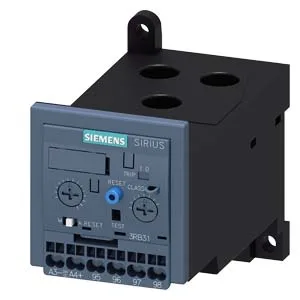
The Siemens 3RB3133-4UX1 is a SIRIUS solid-state overload relay, size S2, designed for motor protection in control panels. It sits between the contactor and the motor, monitoring current via straight-through transformers and tripping on overload — the note on this variant flags it for message "tripped". The key decision spec here is the adjustable trip class: you set it to CLASS 5E, 10E, 20E, or 30E, which governs how fast it responds to a locked-rotor condition. Class 10E is the standard for most general-purpose motor starts; 20E or 30E buys you the headroom for high-inertia loads like fans or centrifuges where the start curve takes longer.
The relay can handle motor current up to the upper current setting value times 3.5, and the minimum trip threshold is above the lower current setting value. That means it's sized for motor FLA in the range the setting dial covers — typically up to 50 A on a 400 V or 480 V line. The auxiliary contact ratings are given per voltage: 2 A at 24 V, 4 A at 120 V, 3 A at 230 V. These are the contacts you wire into the PLC input or the contactor hold circuit to signal a trip. If you're feeding a 24 VDC PLC input, the 2 A rating is well above the signal draw, but watch the voltage drop on long cable runs — it's a dry contact, not a powered output.
This relay is designed for stand-alone installation — it does not clip directly onto a contactor like a bimetallic block. You mount it on a DIN rail or a panel plate, then wire the motor leads through the straight-through transformers. The footprint is 55 mm wide, 81 mm high, 109 mm deep. That's a standard S2 relay footprint; it will fit alongside a SIRIUS 3RT contactor of the same frame size, but you'll need to account for the wiring clearance above and below the transformers.
Storage and transport range is -40 to +80 °C. Shock resistance is rated at 15g for 11 ms, and vibration resistance follows 1-6 Hz at 15 mm amplitude, then 6-500 Hz at 20 m/s² for 10 cycles. These numbers tell you the relay will hold up in a panel mounted on a pump skid or a conveyor drive — not a high-vibration crusher, but standard industrial machinery. The signaling contact (97/98) in the tripped position has a lower shock rating of 8g / 11 ms, so if the panel sees repeated hammering, the trip signal might chatter before the main relay body gives up.