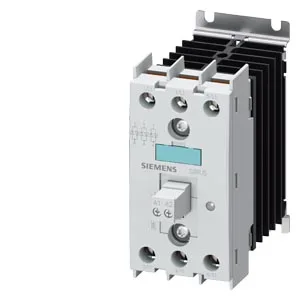
The Siemens SIRIUS 3RF2410-1AC55 is a three-phase controlled solid-state contactor rated for zero-point switching. It's built to handle resistive loads in the AC-51 duty class, carrying 10.5 A per the IEC 60947-4-3 standard, and 7 A under UL 508. The control supply takes 180 to 230 VAC at 50 or 60 Hz, drawing about 15 mA. That zero-point switching means the thyristors turn on when the voltage waveform crosses zero, which keeps electrical noise down and extends heater or lamp life — a real advantage on a production line where you don't want relay chatter tripping a controller.
Sizing and Selection
The headline number here is the AC-51 rating of 10.5 A — that's resistive loads like heaters or incandescent lighting. For motor loads or mixed inductive stuff, you'd need to derate; the UL 508 figure of 7 A gives a more conservative line. The minimum operational current is 500 mA, so it won't reliably switch a tiny pilot light or PLC output without a bleed resistor. Each pole dissipates 10.33 W, so if you're packing several side-by-side on a DIN rail — and it does support side-by-side mounting — you'll want to keep an eye on the ambient temperature. The derating temperature kicks in at 40 °C, meaning above that, the current-carrying capacity drops. In a crowded panel, that's the spec that decides whether you need a gap or a fan.
Depth is 96.5 mm, so check your enclosure depth before buttoning up the gland plate. Terminals are screw-type for both the main circuit and the control circuit, accepting solid wire from 1.5 to 6 mm² on the main side and 0.5 to 2.5 mm² on the control side. The pollution degree is 3, which is the usual industrial environment — conductive dust or condensation is expected, so keep it in a rated enclosure.