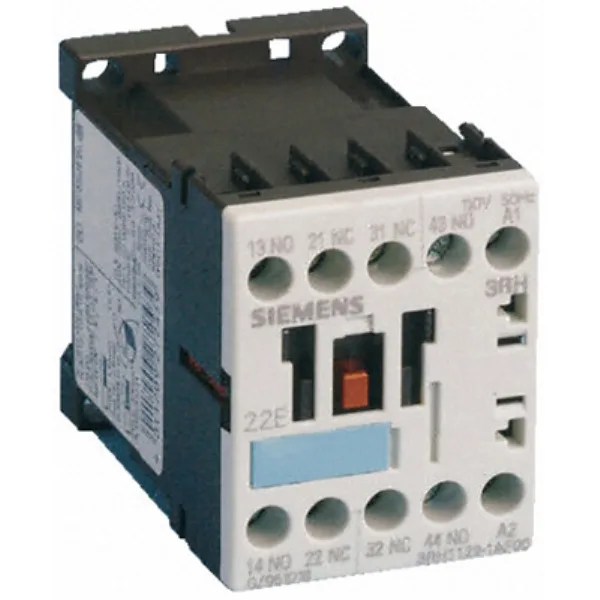
The Siemens 3RH1122-1BB40-0AA6 is a SIRIUS auxiliary contactor — a 4-pole switching block (2 NO + 2 NC instantaneous contacts) designed for control-circuit isolation, signal interlocking, and extending the auxiliary contact count on a motor contactor or as a standalone logic element in a panel. It is built to the S00 frame size, the smallest footprint in the SIRIUS contactor family, and is rated for a 24 V DC coil that draws 3.2 W on pickup and 3.2 W holding — a constant-hold coil, so no power savings from a DC economizer, but the steady draw simplifies the control transformer sizing.
Terminals accept 2x (0.5 to 1.5 mm²), 2x (0.75 to 2.5 mm²), or 2x 4 mm² solid/stranded — the dual-wire entry per clamp is handy for daisy-chaining control voltage to multiple devices without extra terminal blocks.
The 24 V DC rated current is 10 A — that's the continuous carry current for the auxiliary contacts at that voltage, not the motor-starting current. For AC loads, the 230 V rating is 6 A and the 400 V rating is 3 A, so it's sized for control transformers, solenoid valves, and contactor coils, not power circuits. At higher DC voltages the current drops sharply: 1 A at 110 V DC, 0.27 A at 220 V DC — the DC arc extinction limits the switching capacity, so if you're breaking a DC solenoid at 220 V, verify the load current is under 0.27 A.
RoHS compliance date is July 1, 2006, which covers the EU RoHS directive; the part carries the substance prohibitance marking for that date.