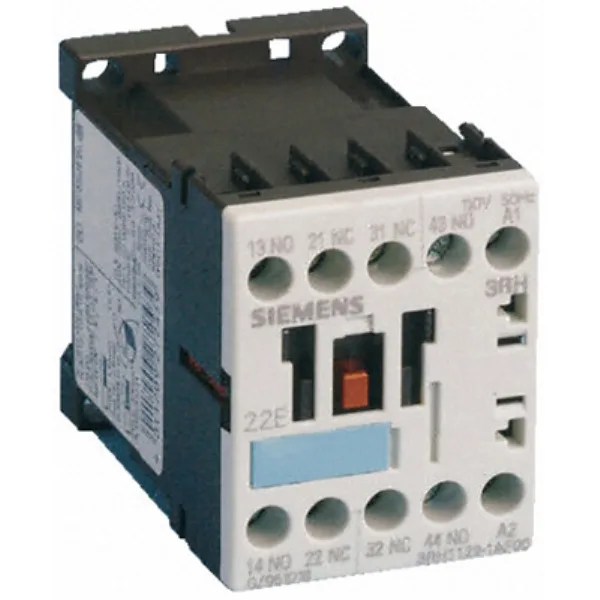
It carries a 125 V DC coil with an integrated varistor surge suppressor, so you don't need to add a separate suppression diode or RC snubber across the coil terminals. That saves a wiring step and a part on the BOM.
The contact set is 2 NO + 2 instantaneous contacts (the 2 in the order code). Rated operational currents are given per voltage: 10 A at 24 V, 1 A at 110 V, 0.27 A at 220 V, 6 A at 230 V, 3 A at 400 V, 2 A at 500 V, and 1 A at 690 V. These are AC ratings for general-purpose switching — think control transformers, relay coils, signal lamps, PLC inputs. The 10 A at 24 V handles a bank of contactor coils; the 1 A at 690 V tells you it can switch a small motor contactor in a 690 V line. Contact reliability is specified at one incorrect switching operation per 100 million cycles at 17 V, 1 mA — that covers dry-contact PLC-level signals without stuttering.
That matters when you're shoehorning it into a tight corner of a panel.
Coil power and wiring
Closing power of the magnet coil at DC is 11 W; holding power drops to 4 W. That's typical for a DC-operated contactor — the inrush is higher to pull in, then the holding circuit reduces power. The varistor across the coil absorbs the back-EMF spike when the coil de-energizes, which is the main reason DC coils need external suppression. Here it's built in. Terminal capacity accepts 2x (0.5...1.5 mm²), 2x (0.75...2.5 mm²), or 2x 4 mm² solid/stranded — covers common control wiring sizes without needing ferrules for the smaller strands.