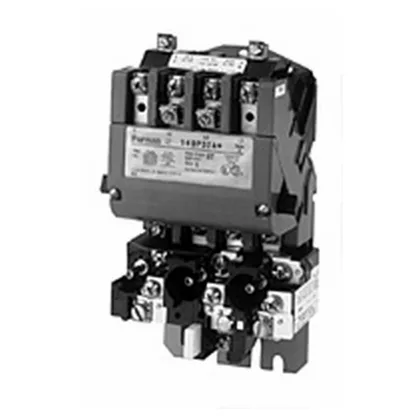
It carries 4 normally-open instantaneous contacts, with no leading, lagging, delayed, or make-before-break switching. That's a straight NO-only block: you get four independent contact sets that close and open together. Mounting is screw-fixed or snap-on onto a DIN rail. The size S00 envelope — 90 mm wide × 57.5 mm high × 72 mm deep — fits the standard panel grid; it occupies roughly the same footprint as a miniature circuit breaker.
The contact ratings are given at specific voltages, and they drop fast as voltage rises. At 24 V it's rated 10 A; at 230 V it's 6 A; at 400 V it's 3 A; at 690 V it's just 1 A. That's typical for an auxiliary contactor — the contacts are sized for control signals and small loads, not power circuits. If you're switching a 24 VDC PLC output or a 230 VAC pilot light, this block handles it. Don't try to break a motor starter's main coil at 400 V with it — that's what the contactor's own auxiliary contacts are for. That's a dry-circuit rating — low energy, gold-flash territory. For most industrial control circuits (24 V, tens of mA), it's effectively wear-out limited, not contact-stability limited.
The SIRIUS platform is widely stocked, so cross-references are straightforward. The 3RH1440-1AK60 is the 4-NO variant; if your BOM calls for a different contact arrangement (e.g., 2 NO + 2 NC), that's a different order code in the same size S00 family. No functional second-source exists outside Siemens — the auxiliary contactor market is brand-locked to the panel design.
Screw terminals accept 2× (0.5…1.5 mm²), 2× (0.75…2.5 mm²), or 2× 4 mm² solid. That's two conductors per clamp — handy for daisy-chaining common signals. Strip length is standard 8–10 mm; use ferrules on stranded wire to avoid whiskers under the cage. Shock resistance is 10g / 5 ms and 5g / 10 ms — fine for most industrial panels, but if your machine sees repetitive hammering from a press or crusher, check the mounting orientation: the contactor can be rotated ±180° on a vertical surface and tilted ±22.5° forward/backward. Keep the cabinet climate-controlled if condensation is a risk.