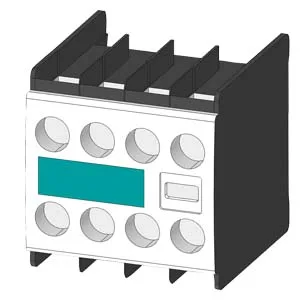
It carries a maximum thermal current of 10 A, with the actual switching capacity depending on the circuit voltage — for example, 6 A at 24 V AC/DC, 3 A at 110 V, and 0.3 A at 220 V. The screw-type terminals accept 2x (0.5 to 1.5 mm²) or 2x (0.75 to 2.5 mm²) solid or ferruled stranded wire, or the AWG equivalents 2x (20–16) and 2x (18–14). Mechanical life is rated at 10 million switching cycles typical, and contact reliability is specified as 1 faulty switching per 100 million operations at 17 V, 1 mA — a figure that matters for low-energy PLC inputs where oxide films on dry contacts can cause intermittents.
Snap-on mounting onto the contactor or contactor relay — no tools needed, no DIN rail required. The block adds 36.5 mm width and 41.5 mm depth to the S00 base unit. Front-side protection class is IP20, so it is suitable for enclosed panels where the operator does not contact live parts.
The 10 A maximum is the unrestricted thermal current (Ith). The real limit is the AC-15 utilization category at 690 V: 1 A. That is the rating that governs switching of electromagnetic loads like contactor coils and solenoid valves. For DC switching, the voltage-dependent current table gives the safe break capacity — for a 24 V DC inductive load, the contact is rated at 6 A; at 60 V DC it drops to 2 A; at 220 V DC it is only 0.3 A. If your circuit operates above these DC values, the contacts may not interrupt the arc reliably. The contact reliability figure (1 failure per 100 million at 17 V, 1 mA) confirms the block is suitable for dry-signal PLC inputs where gold-plated contacts are not used.