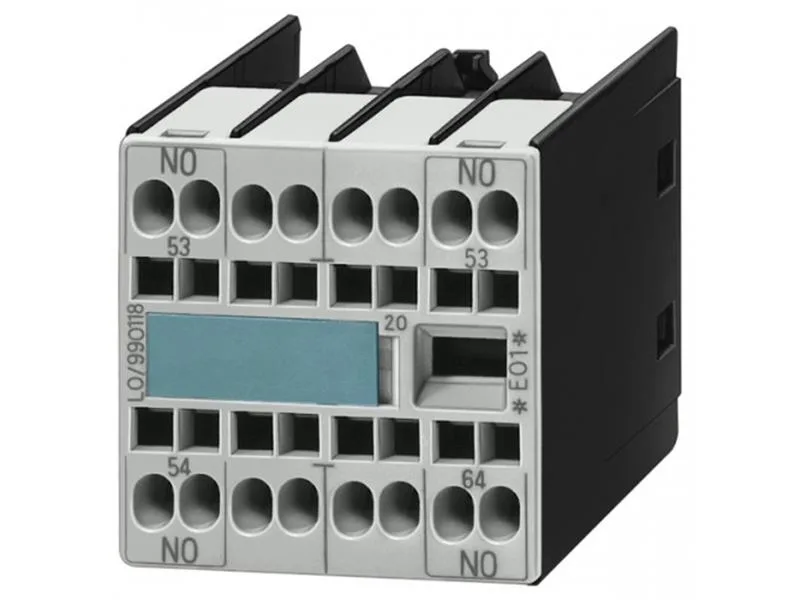
It uses spring-loaded terminals for the auxiliary and control current circuit, accepting 2x (0.5... 1.5 mm²) with core-end processing or 2x (0.5... 2.5 mm²) without. The block is rated for a maximum current of 10 A, with switching capacity that varies significantly by voltage: 6 A at 24 V, 6 A at 125 V, 6 A at 230 V, 6 A at 250 V, 3 A at 400 V, and 0.3 A at 220 V. This voltage-dependent derating means the 10 A headline figure applies only at the lowest voltages; at 400 V the block is good for 3 A, and at 220 V for just 0.3 A — critical for control-circuit design where the load voltage may differ from the coil voltage.
The block snaps onto a size S00 contactor or contactor relay, adding two NO auxiliary contacts without increasing the panel footprint beyond the contactor's own width of 36.5 mm and depth of 46 mm. The spring-loaded terminals accept AWG 20–14 conductors (2x) and require no screwdriver torque control, which speeds up wiring in high-density panels.
Lifecycle Reality and Sourcing
The 3RH1911-2FA20 is a phased-out product. The official Siemens successor is the SIRIUS 3RH2911-2HA20, which is the preferred replacement type. The mechanical service life is rated at 10,000,000 switching cycles typical, and contact reliability is specified as one incorrect switching operation per 100 million at 17 V, 5 mA, so the block is suitable for high-cycle applications where a direct replacement is needed.
The insulation voltage is rated at 690 V with pollution degree 3, and surge voltage resistance is 6 kV — these figures define the block's suitability for 400 V and 690 V control circuits in industrial environments where overvoltage transients are common. The auxiliary contacts are also rated for AC-15 duty at 690 V at 1 A, which covers solenoid and contactor coil switching at higher voltages.