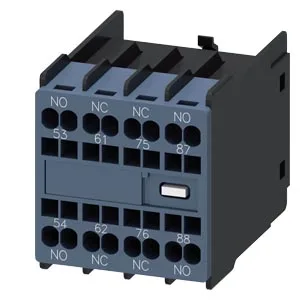
What this block does in a panel
The 3RH2911-2FB22-0MA0: This is the front-mounted auxiliary switch block for SIRIUS contactors and contactor relays — specifically the 3RT2 and 3RH2 families. It snaps onto the front of the device (no tools, no DIN-rail space) and gives you four contacts: two normally open, two normally closed, with one NO leading and one NC lagging. The spring-loaded terminals accept 2x (0.5 to 1.5 mm²) with ferrule or 2x (0.5 to 2.5 mm²) solid, plus AWG 20–14. Rated for 10 A maximum, with a contact reliability of 1 faulty switching per 100 million operations at 17 V, 1 mA.
Current ratings — what the voltages mean for your circuit
The 10 A maximum is the thermal current (Ith); the actual switching capacity depends on voltage and load type. At 24 V the block switches 6 A (AC-15 at 690 V is rated 1 A). For DC circuits the derating is steeper: 6 A at 24 V, 2 A at 60 V, 1 A at 110 V, 0.3 A at 220 V. The AC-15 rating at 690 V is 1 A — that's the inductive load curve for contactor coils and solenoids. If you're switching a 24 VDC pilot light or PLC output, the 6 A at 24 V gives plenty of headroom; for a 220 VDC brake coil, the 0.3 A limit means you need to check the inrush.
Mounting and wiring reality
Snap-on mounting means it clips directly onto the contactor or relay front — no DIN rail, no screws. The block is 36 mm wide, 47.7 mm deep, 41.5 mm high. Spring-loaded terminals: strip 8 mm, push the wire in. The terminal layout is marked on the block: 11 U, 53/54, 61/62, 75/76, 87/88. One NO is a leading contact (closes before the main contacts), one NC is lagging (opens after).