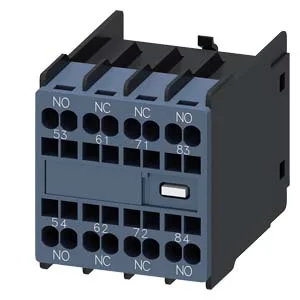
The Siemens 3RH2911-2GA22-ZW96 is a front-mounted auxiliary switch block for the SIRIUS contactor relay line, specifically designed to mate with the 3RH2140 and 3RH2440 contactor relays per EN 50011. It provides 2 normally-open and 2 normally-closed instantaneous contacts, wired to terminals 53/54, 61/62, 71/72, and 83/84, giving you four discrete signal paths off the relay's armature position. Snap it onto a DIN rail — the fastening method is snap-on mounting, so it clips into the same rail the contactor relay sits on, no tools needed for the mechanical install. The spring-loaded terminals accept 2x (0.5 to 2.5 mm²) solid wire or 2x (0.5 to 1.5 mm²) with ferrules, and the equivalent AWG range is 2x (20 to 14).
The headline maximum is 10 A, but that's a thermal current rating — the real switching capacity depends on the voltage and load type. At 24 V it handles 6 A; at 230 V it still carries 6 A; at 400 V it drops to 3 A. For DC switching, the numbers tighten: 24 V at 10 A, 60 V at 4.7 A, 110 V at 3 A, 220 V at 1.2 A, and 600 V at just 0.26 A. The AC-15 rating at 690 V is 1 A — that's the inductive load curve for solenoid valves and contactor coils at higher voltages. Mechanical service life is 10 million switching cycles typical, so this block outlasts most contactor relays it rides on. Surge voltage resistance is 6 kV, and insulation voltage at pollution degree 3 is 690 V AC.
Wiring and integration notes
The spring-loaded terminals are physically coded — the housing has a keying feature that prevents inserting the wrong terminal type. Wire preparation is standard: strip to 8 mm, insert solid or ferruled stranded, and the cage clamps automatically. No screwdriver needed for the connection, which speeds up panel wiring on repetitive builds. Dimensions are compact: 36 mm wide, 41.5 mm tall, 47.7 mm deep. It sits flush on the front of the contactor relay, so it doesn't increase the panel depth beyond the relay's own envelope. The 2 NO + 2 NC contact arrangement follows EN 50011 for auxiliary contact blocks, meaning the terminal numbering is standardized across the SIRIUS family.