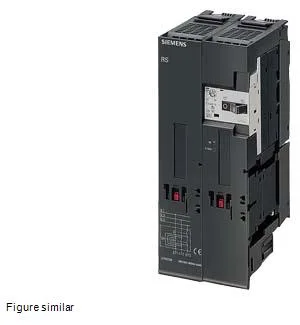
The Siemens 3RK1301-0EB00-1AA2 is a SIMATIC-branded reversing motor starter — a single device that handles forward and reverse direction for a three-phase motor without needing separate contactors. It's designed as a reversing starter, meaning it integrates the interlocking and power switching for bidirectional motor control in one package. The control voltage is 24 V DC, with a permissible range of 20.4 to 28.8 V, so it will hold in during a sagging 24 V supply but drops out cleanly below the threshold. Communication is handled via PROFINET protocol, so it integrates directly into a Siemens automation network without an extra gateway. The module also supports PROFIBUS DP, giving flexibility for legacy bus architectures.
Fastening is pluggable on a terminal module — no tools needed for the mechanical mount, but the main energy infeed uses screw-type terminals, so you'll need a screwdriver for the power wiring. The mounting position is vertical or horizontal, which helps when panel layout is tight. Dimensions are 265 mm high, 90 mm wide, and 120 mm deep — that's a fairly tall module, so check the enclosure depth before committing the gland plate. Vibration resistance is 2g, shock resistance is 5g for 11 ms — fine for most industrial panels but not for direct machine-mount on a vibrating press. Pollution degree is rated at 3 for 400 V and 2 for 500 V per IEC 60664, so it's suitable for industrial environments with conductive dust or occasional condensation.
The reversing starter has no direct start capability — it's designed for reversing duty only, so if your application needs a simple non-reversing starter, this isn't the part. It accepts 1 byte of inputs and 1 byte of outputs, so the I/O count is minimal; digital I/O are handled via a separate control module, not onboard. The power dissipation with bypass circuit is 4.1184 W, without bypass it's 4.118 W — negligible for panel heat calculation but worth noting if you're packing many units in a sealed enclosure. Maximum operating frequency is 750 cycles per hour — that's about one start every 4.8 seconds, which is fine for most reversing conveyor or gate applications but not for high-cycle positioning. Reverse starting is supported, as expected for a reversing starter.