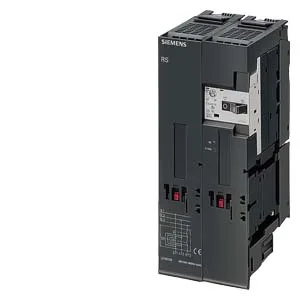
What this reversing starter does — and what it doesn't
The 3RK1301-0KB00-1AA2 is a SIMATIC reversing motor starter — a single unit that handles forward and reverse direction control for a motor load, with integrated overload protection rated Class 10. It is not a direct-start device; the reversing function is built in, so the BOM line replaces what would otherwise be two contactors, a mechanical interlock, and a separate overload relay.
Fieldbus and I/O — what the control module brings
This starter supports both PROFINET and PROFIBUS DP protocols, so it drops into either a SIMATIC S7-1500 PROFINET ring or a legacy PROFIBUS DP segment without a gateway. The I/O mapping is 1 byte of inputs and 1 byte of outputs — enough for basic status and control signals (run forward, run reverse, fault reset, overload trip). Digital I/O are not on the base unit; they are added via a separate control module that plugs into the starter's top interface.
The starter mounts by plugging onto a terminal module — no DIN-rail clips, no screws into the panel base. Dimensions are 265 mm high, 90 mm wide, 120 mm deep. The width is the critical panel-spacing number: at 90 mm, it occupies roughly five 18 mm-wide DIN-rail terminal positions. Mounting can be vertical or horizontal, which gives flexibility in shallow enclosures.
The unit is rated for pollution degree 3 at 400 V and degree 2 at 500 V per IEC 60664 / IEC 61131 — meaning it tolerates conductive pollution (condensation, light dust) at 400 V but requires a cleaner environment at 500 V. Shock resistance is 5 g for 11 ms; vibration resistance is 2 g. Maximum switching frequency is 750 operations per hour. Power dissipation is 4.118 W without bypass, 4.1184 W with bypass — negligible for enclosure thermal calculations.
Supply voltage and control logic
The control supply is 24 V DC nominal, with a permissible range of 20.4 to 28.8 V DC. The unit does not include brake control for either 24 V DC or 180 V DC brakes — if the motor has a brake, it must be controlled externally. Reverse starting is supported; direct starting is not, which is consistent with the reversing-starter design.