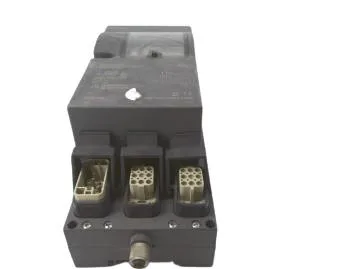
The Siemens 3RK1322-0HS02-1AA0 is an AS-interface compact reversing starter in an IP65 enclosure, designed for direct-on-line motor control in distributed automation layouts. It combines a reversing contactor, bimetal overload relay, and short-circuit protection (via integrated circuit-breakers) into a single housing that mounts outside the control panel, close to the motor. Rated for AC-3 duty at 400 V, it switches a 0.21 kW motor load — the setting range of 0.55 to 0.8 A covers small three-phase induction motors typical of conveyor drives, valve actuators, or fan starters in washdown zones. Communication is over AS-interface (AS-i) protocol, carrying start/stop and direction commands from the controller without a separate control cable bundle. The 9-pole motor outgoing feeder and 9-pole power connection handle the motor leads and feedback signals through a single connector interface, reducing field wiring time.
The headline rating is the AC-3 motor switching capacity: 0.21 kW at 400 V. This is the maximum three-phase induction motor load the starter can handle under the standard duty cycle (starting, running, stopping). The setting range of 0.55 to 0.8 A on the bimetal overload relay means you dial in the motor's full-load current within that window — if your motor draws 0.7 A, this starter is a direct fit. Outside that range, you need a different unit. The short-circuit breaking capacity (Icu) is 50,000 A at 400 V. That is a high fault-current rating for a compact starter — it safely interrupts a bolted fault up to 50 kA without welding the contacts or rupturing the enclosure. This matters when the starter sits downstream of a high-capacity transformer or in a plant with stiff utility feed. The integrated circuit-breakers provide the short-circuit protection; you do not need a separate upstream fuse or MCCB for the starter branch. The bimetal overload relay compensates for ambient changes within that band, so the trip curve stays accurate. Below -25 °C the lubricants in the electromechanical contacts may stiffen; above +55 °C the overload relay may nuisance-trip before the motor reaches full temperature.
This is a panel-less starter — the IP65 enclosure bolts directly to the machine frame, a stand-off bracket, or a wall-mounted gland plate. No DIN rail inside a cabinet needed. Dimensions are 120 mm wide by 270 mm high by 190 mm deep. Plan for clearance around the cable entries and the AS-i tap — the 9-pole connectors on the motor side and the power side each need about 80 mm of free space for the mating plug to engage fully. The electromechanical reversing contactor inside provides mechanical and electrical interlocking between forward and reverse directions — no external interlock wiring required. The bimetal overload relay trips on motor overcurrent and resets manually after the fault clears.
The AS-i network addressing and the 9-pole connector pattern are fixed in the design; there is no alternate pinout or firmware variant to verify. Source it against an RFQ for the specific quantity and delivery window.