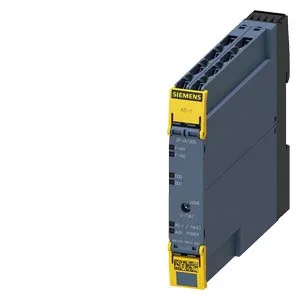
The Siemens 3RK1405-2BE00-2AA2 is a Slimline Compact I/O module for control-cabinet use, part of the AS-Interface SC17.5F family. It packs two safety-related digital inputs and two PNP transistor outputs into a 17.5 mm wide housing that screws or snaps onto the DIN rail. It is a standard AS-i slave with profile S-7.B.F, addressable via a front socket. The safe failure fraction (SFF) of 99 % and Category 4 per EN ISO 13849-1 mean this module is built for safety circuits up to the highest performance level — think emergency stop zones, light curtain integration, or two-hand control on a press line. The module draws 0.2 A when powered solely through the AS-Interface cable, or 0.5 A when an auxiliary 24 V DC supply (Uaux) is connected. That auxiliary feed, between 20 and 30 V DC, must be PELV per IEC 60990 and is required to drive the output circuits — the AS-i bus alone cannot source the output current.
The 2 safety inputs accept mechanical contacts (e.g. E-stop pushbuttons, door switches) and the 2 PNP outputs are short-circuit proof — a practical detail if you are driving small contactors or indicator lamps directly. The outputs can be powered either from the AS-i bus or from Uaux, selectable per application. Rated IP20 means it is for the clean, dry environment inside an enclosure — not for washdown or outdoor use. The operating range of -25 to +70 °C covers most cabinet conditions, and the 15g / 11 ms shock resistance (10g with the device connector) tells you it can handle moderate vibration on a machine frame. Wire termination accepts 1 or 2 solid conductors up to 2.5 mm², or finely stranded with ferrules up to 2.5 mm². Stranded wire without ferrules is not permitted, and AWG stranded is also not permitted — so plan for ferrules if your shop uses stranded cable.
Width of 17.5 mm means it occupies one standard DIN-rail slot — tight enough for dense cabinets. Depth of 120 mm and height of 100 mm fit within typical enclosure depths; no special clearance needed above or below. The ID1 code is set to F at the factory and is changeable via the front socket. Addressing is done through the same socket, not DIP switches — plan for a handheld addressing unit during commissioning.