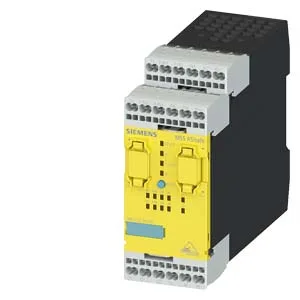
The Siemens 3RK3122-2AC00 is a SIRIUS Modular Safety System central unit — the brain of a distributed safety island. It packs 2 fail-safe digital inputs (configurable as 2- or 4-channel), 4 standard digital inputs, 1 fail-safe relay output, and 1 fail-safe digital output into a 45 mm wide DIN-rail housing. That means you can wire emergency stops, light curtains, and valve monitoring (yes, it does valve monitoring) into one module and get SIL CL 3 per IEC 61508 out of it — enough for most Category 3 or 4 safety circuits up to PL e. Rated for SIL CL 3 (IEC 61508) and SIL 3 (IEC 62061), it handles both 1-channel and 2-channel safety inputs. The 2-channel inputs are the ones that matter for redundancy — single-channel is there for simpler guarding where a single break is acceptable. You can set the input delay from 0 to 150 ms to filter out contact bounce on mechanical switches.
Where it lives in the panel
Mount it vertical on a DIN rail (snap-on) or screw it down with the optional push-in lug — your choice. It's IP20 on the enclosure and terminals, so it's strictly inside a cabinet; no washdown ratings here. At 45 mm wide and 124 mm deep, it leaves room for expansion modules alongside on the same rail. The spring-cage terminals accept 2 x 24–16 AWG solid or stranded, so you can daisy-chain safety loops without extra terminal blocks. Storage and transport go from -40 to +85 °C, so it survives a cold truck ride. Shock resistance is 15g / 11 ms, which handles the vibration you'd see on a machine-mounted panel.
SIL CL 3 (IEC 61508) means this module can be used in safety functions up to SIL 3, which covers the vast majority of industrial guarding applications — press brakes, robotic cells, conveyor zones. The 2-channel input structure lets you wire dual-channel emergency stops or interlock switches with cross-fault detection. The fail-safe relay output (F-RO) switches safety loads directly; the fail-safe digital output (F-DO) can drive a contactor or a pilot light. Both are parameterizable via the engineering software — you can set the output behavior on fault, the startup test (monitored start-up is supported), and the input debounce time. The PROFIBUS DP interface (when used with the DP interface module) handles 64 bits of cyclical data — enough to map all the I/O points and diagnostics into a PLC without straining the bus cycle time. The module itself doesn't have a built-in fieldbus port; you add the interface module alongside on the DIN rail.