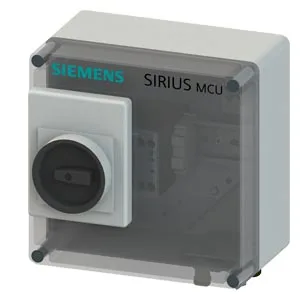
Motor starter for direct-on-line control
Control supply voltage is 20.4 to 26.4 V DC. The IP55 enclosure means the starter handles washdown and dust — suitable for food-and-bev lines, conveyor tunnels, or any area where hose-down cleaning is routine.
The starter carries no PROFINET, PROFIBUS, or AS-Interface protocol support — it is an I/O-controlled unit, so it lands on a hardwired digital output from the PLC or a remote I/O slice. No fieldbus gateway is built in.
The 10 A AC-3 rating at 400 V governs motor switching — that is the current the contacts can make and break across a motor load (high inrush, inductive). The same unit also carries a 10 A rating at AC at 400 V, which covers the resistive (AC-1) case. For a 4-pole induction motor on 400 V, 10 A full-load amps corresponds roughly to a 4 kW motor; verify the exact FLA on the nameplate. The 50 % low-demand rate and 75 % high-demand rate per SN 31920 define the duty cycle for the internal switching elements; stay within these to avoid premature contact wear. The operating frequency minimum of 80 operations per hour is the thermal limit for the starter mechanism under continuous cycling — not a hard ceiling for occasional jogging, but sustained high-frequency switching above this rate will exceed the thermal capacity of the bimetal and contacts.