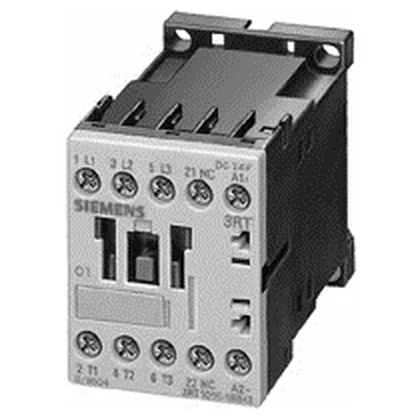
Its 24 VDC coil pulls in reliably, and the three main poles handle AC-3 duty up to 4.5 kW at 500 V and 5.5 kW at 690 V. The auxiliary contact block provides one normally-open and one normally-closed set rated at 10 A at 24 VDC. The mechanical life of 30 million operations means the contactor will outlast most panel refreshes if the electrical load is kept within its AC-3 curve.
Side-by-side mounting is permitted with 6 mm spacing to adjacent devices, which keeps the panel layout tight. The screw-type terminals accept 2x (0.5 to 1.5 mm²) solid, 2x (0.75 to 2.5 mm²) stranded, or up to 1x 12 AWG — common wire sizes for motor starters in this frame class. The pollution degree 3 rating confirms it is designed for the conductive dust and humidity typical of industrial control rooms.
For Type 1 coordination (contactor may need replacement after a fault), the fuse rating goes up to 35 A. These values are for the main circuit and should be matched when designing the motor branch circuit. The operating temperature range of -25 to +60 °C covers most panel environments, but the coil hold-in voltage tolerance at 50 Hz is 0.8 to 1.1 times rated — at 60 Hz it tightens to 0.85 to 1.1. If your control transformer is marginal on voltage, the 60 Hz drop-out margin is narrower.