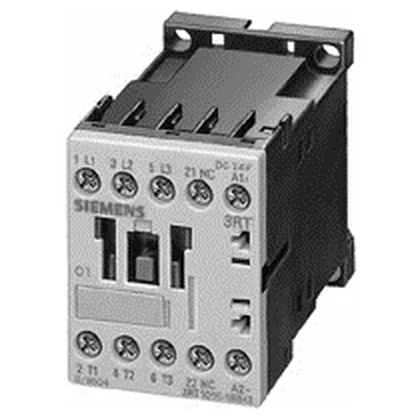
It is rated for a 120 V 60 Hz coil, so it pulls in cleanly on standard North American control voltages at line frequency.
For motor duty, the contactor is rated 4 kW at AC-2 at 400 V — that covers slip-ring motor starting and reversing. For the tougher AC-4 duty (plugging, inching, reversing under load), it handles 8.5 A at 400 V. At 690 V it can switch a 5.5 kW motor, so it suits 690 V line applications common in mining or heavy industrial sites. The auxiliary contact block (integrated) is rated 10 A at 24 V, 6 A at 230 V, and 0.3 A at 220 V — enough for PLC inputs or relay coils in the control circuit. The front face carries IP20, and the terminals are also IP20, so it is safe for finger-probe access inside an enclosed panel. For short-circuit protection, the contactor is coordinated with a 20 A gL/gG fuse for Type 2 coordination (no welding of contacts) and a 35 A fuse for Type 1 (welding allowed but no fire risk). The main circuit uses screw-type terminals accepting 2x (0.5 to 1.5 mm²) or 2x (0.75 to 2.5 mm²) solid/stranded, or up to 2x (0.75 to 4 mm²) — typical for panel wiring up to 4 mm².