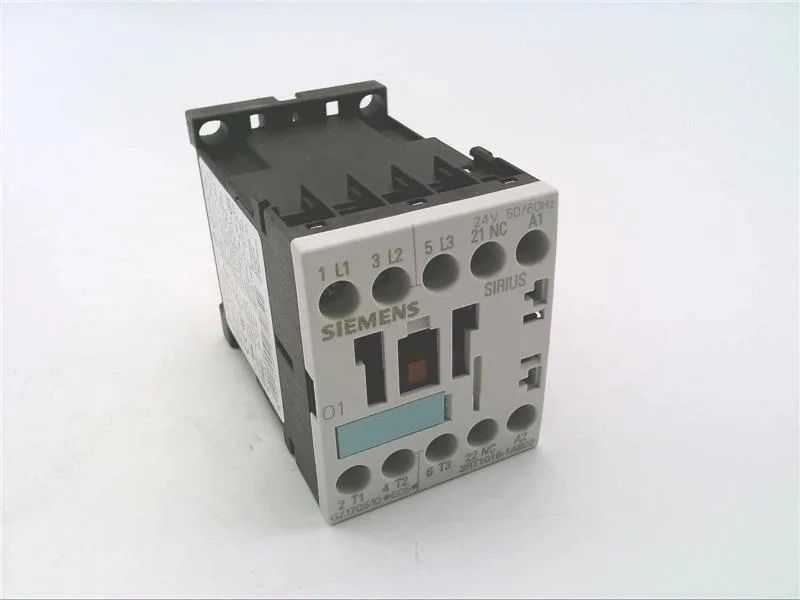
The 24 VDC coil draws its rated current at 50/60 Hz, with a holding range of 0.8 to 1.1 times rated voltage at 50 Hz and 0.85 to 1.1 at 60 Hz. This means the coil stays pulled in reliably even if the control supply sags to about 19 VDC. For motor duty, the contactor is rated 4.5 kW at 500 V and 5.5 kW at 690 V — the higher voltage rating gives more power through the same frame because current is lower. In AC-2 duty (slip-ring motors) it handles 4 kW at 400 V; in AC-4 duty (plugging/inching) it switches 8.5 A at 400 V.
The 45 mm width is the panel-space constraint — three of these fit in a standard 145 mm DIN-rail section, leaving room for a terminal block. Depth is 72 mm, height 57.5 mm, so it clears most shallow enclosures. The IP20 front protection means tools or fingers can contact live parts if the panel door is open; it expects enclosure protection. Operating temperature range of -25 to +60 °C covers most plant-floor conditions, but the mechanical life of 30 million cycles is typical for Size S00 — expect fewer cycles under heavy AC-4 switching due to contact wear.
For BOM freeze or compliance documentation, the SIRIUS series typically provides CE, UL, and CSA declarations. The contactor carries pollution degree 3 and IP20 ratings, which align with IEC 60947-4-1 requirements for motor starters.
Screw terminals accept 2x (0.5 to 1.5 mm²), 2x (0.75 to 2.5 mm²), or max 2x (0.75 to 4 mm²) solid/stranded wire — AWG equivalents are 2x (20 to 16), 2x (18 to 14), or 1x 12. This covers most motor and control wiring in a standard panel. For short-circuit coordination, Type 2 requires a 20 A gL/gG fuse; Type 1 allows a 35 A gL/gG fuse. Type 2 coordination means the contactor remains usable after a fault — important for production lines where downtime for replacement is costly. The 6 mm clearance to adjacent components on the side is the minimum for heat dissipation.