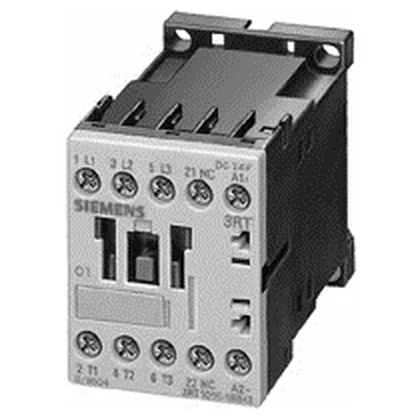
The Siemens 3RT1017-1AR61 is a SIRIUS power contactor in the compact S00 frame, with an AC-2 rating of 5.5 kW at 400 V and an AC-4 rating of 8.5 A at 400 V for reversing or jogging duty. It snaps onto a 35 mm DIN rail per EN 50022 and measures 45 mm wide by 57.5 mm tall by 72 mm deep — a footprint that fits tightly packed panels where every millimeter of DIN rail space is accounted for. The screw-type terminals accept solid or stranded conductors from 0.5 mm² up to 4 mm² (2x per terminal), and the front face carries an IP20 rating for basic finger-safe touch protection in an enclosure.
The AC-4 8.5 A at 400 V matters when you need to reverse or plug the motor — that's the worst-case current the contacts see during inching or counter-torque braking.
Coil and control circuit specifics
The coil operates at 50/60 Hz with a voltage tolerance of 0.85 to 1.1 times rated, and the holding currents are listed per voltage: 10 A at 24 V DC, 2 A at 60 V DC, 1 A at 110 V DC, 0.3 A at 220 V DC, 6 A at 230 V AC, and 3 A at 400 V AC — these are the steady-state draws your PLC output or relay must supply once the contactor is sealed in. With a single instantaneous contact (1 NO or 1 NC depending on wiring), the 3RT1017-1AR61 gives you one feedback signal to the controller — enough for a run-status indication, but not for separate on/off confirmation without an auxiliary contact block.