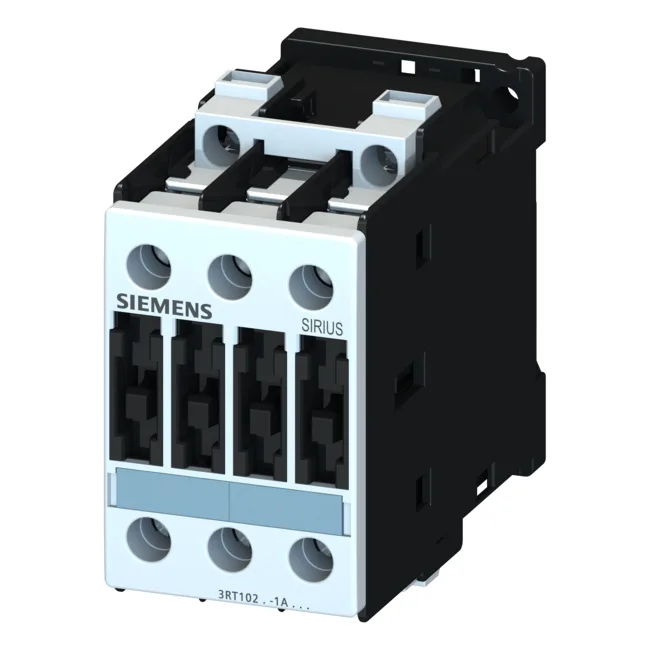
The 45 mm width means it occupies one standard module slot — important when you're packing multiple contactors side by side (side-by-side mounting is supported). This is a current-production part.
The headline number here is 15.5 A at AC-4 utilization category, 400 V. AC-4 covers plugging and inching of motors — the most severe switching duty because the contactor makes and breaks locked-rotor current. If your application is a conveyor that reverses direction under load, or a hoist that jogs into position, this is the rating that governs contact life. Terminal capacity accepts solid conductors from 2x 0.5 mm² up to 2x 4 mm², and stranded up to 2x 10 mm². That covers the range from control wiring up to the main power feed for a 7.5 kW motor at AC-2 (400 V). The 2000 m maximum operating altitude means it's fine for most sites, but if you're at elevation, derate accordingly.
The front face carries IP20 protection, so finger-safe for operators working near the panel. The terminals themselves are IP00, meaning they're live when the panel door is open — standard for this class. For short-circuit coordination, the table lists two fuse sizes depending on the type of coordination. With type 2 coordination, use a 25 A gL/gG fuse. With type 1 coordination, you can go up to 63 A gL/gG. That gives flexibility depending on whether you need to minimize downstream damage after a fault or just clear it.