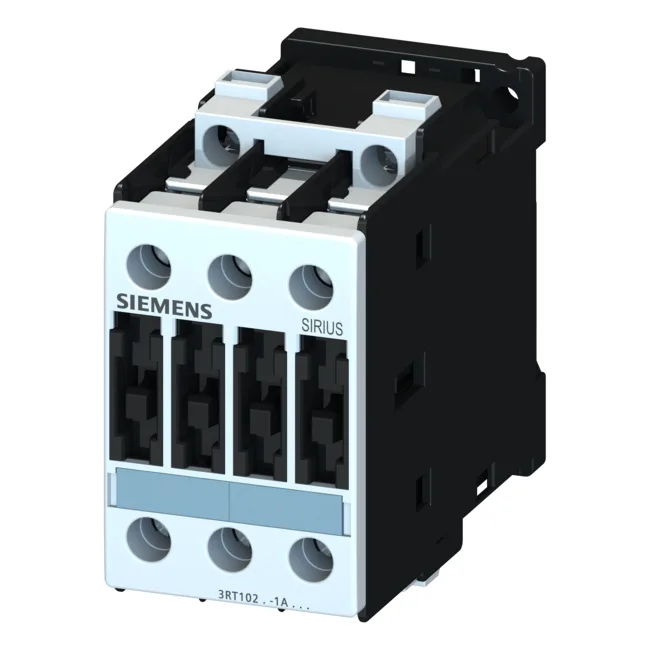
The coil is rated 24 V at both 50 Hz and 60 Hz, with an operating range of 0.8...1.1 times rated voltage at 50 Hz and 0.85...1.1 at 60 Hz — meaning it pulls in reliably even if the control supply sags to about 19 V at 50 Hz or 20.4 V at 60 Hz.
The maximum operational current in AC-12 duty (resistive load, no inrush) is 10 A. That is the continuous current the main contacts can carry in a purely resistive circuit — think heater banks or incandescent lighting. For motor loads, the AC-2 rating at 400 V is 7.5 kW, and the AC-4 rating (plugging/reversing) at 400 V is 15.5 A — a figure that governs the contactor's life in frequent jogging or reversing applications. The auxiliary contact block is rated for switching at various control voltages: 10 A at 24 V, 6 A at 230 V, 3 A at 400 V, and 0.3 A at 220 V DC. That last figure matters if you are switching DC control circuits — the DC rating is much lower than the AC rating because DC arcs are harder to extinguish. Mechanical life is listed at 10 million operations typical — that is the contactor body itself, not the contacts under load. Electrical life depends on the switching current and duty cycle; for AC-3 motor starting you will see fewer operations before contact wear.
Integration notes
The S0 frame is a standard footprint for 45 mm wide contactors up to about 15 kW at 400 V. Side-by-side mounting is allowed (zero gap between units), which saves rail space in multi-contactor panels. The screw terminals are cage-clamp style — strip length is not stated, but typical Siemens S0 terminals need about 8-10 mm strip for solid wire and a ferrule for stranded.