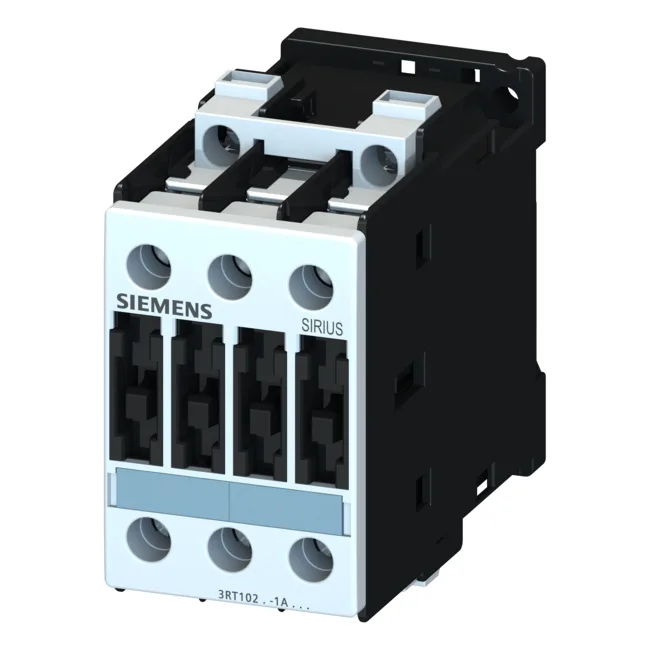
That matches the IP20 front / IP00 terminal enclosure — the terminals are not sealed, so the panel itself must provide the environmental protection. Mechanical endurance is listed at 10,000,000 operating cycles typical. That's the mechanical life of the contactor assembly; electrical life will be lower and depends on the switching current and voltage per the manufacturer's derating curves. Side-by-side mounting is permitted, so no derating for zero-gap spacing.
Termination and Wiring
Main and auxiliary/control circuits use screw-type terminals. The main circuit accepts solid conductors: 2x (0.5 to 1.5 mm²), 2x (0.75 to 2.5 mm²), max 2x (0.75 to 4 mm²). For stranded or ferruled conductors: 2x (1 to 2.5 mm²), 2x (2.5 to 6 mm²), max 2x 10 mm². AWG equivalents are 2x (16 to 12), 2x (14 to 10), 1x 8 for the main contacts, and 2x (20 to 16), 2x (18 to 14), 1x 12 for auxiliary contacts.
Fuse Coordination and Short-Circuit Protection
For type 1 coordination (contactor may need replacement after a fault), the fuse can be up to 100 A gL/gG. This gives the panel designer flexibility: use 35 A fuses if you want to avoid replacing the contactor after a rare fault, or use a higher rating if the upstream protection is already set.