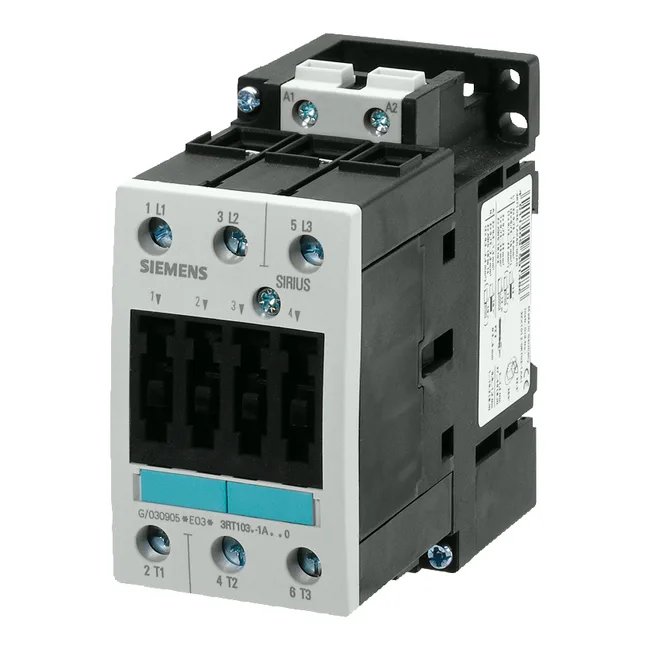
Its screw-type terminals accept solid conductors up to 2x 4 mm² or stranded up to 2x 25 mm², and it mounts via screw or snap-on onto 35 mm DIN rail per EN 50022 — a standard panel integration. The 18.5 kW rating at 500 V (AC-3 duty) tells you it handles typical three-phase induction motors in that power band; the 10 kW at 690 V extends its reach into higher-voltage installations. Side-by-side mounting is permitted, which helps when packing multiple contactors on a DIN rail for a multi-motor group.
Switching frequency and mechanical endurance
Maximum switching frequency depends on duty category: 1 200 cycles/hour for AC-1 (resistive loads), 1 000 for AC-3 (motor starting/running), 750 for AC-2 (slip-ring motors), and 250 for AC-4 (plugging/inching). The typical mechanical life is 10 million cycles, so in a conveyor line cycling once every 20 seconds you'd see well over a decade before mechanical wear is a concern. Arcing time runs 10–15 ms, with a make/break time of 7–20 ms on AC — fast enough for most motor control sequences.
Auxiliary contact ratings and coil data
The auxiliary contact block carries 10 A at 24 V, 6 A at 230 V, and 3 A at 400 V — enough for pilot duty on PLC inputs or relay coils. At 500 V the contactor switches 18.5 kW (AC-3); at 690 V it's rated 10 kW. The coil operates on 50/60 Hz with a voltage tolerance of 0.8 to 1.1 times nominal, so a 230 V coil holds in at 184 V and picks up reliably at 253 V.