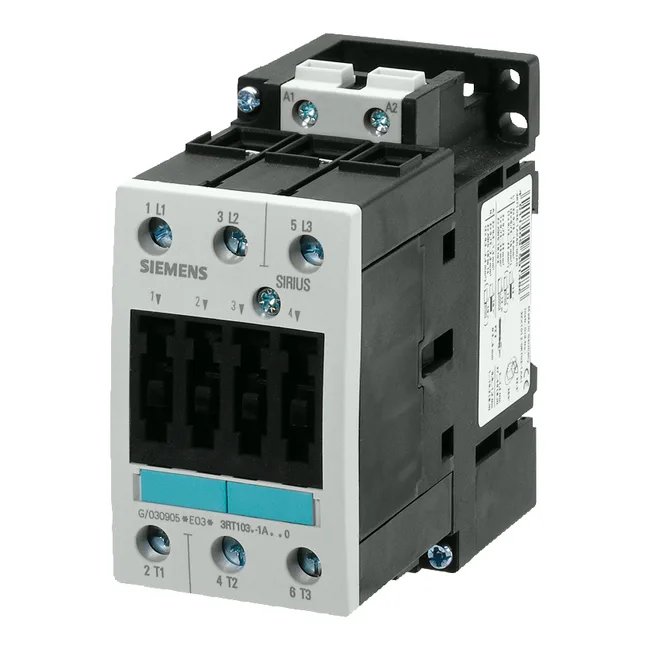
What it is and what it does
The Siemens 3RT1034-1AP04-3MA0 is a SIRIUS power contactor in the S2 frame size, designed for switching motor loads in industrial control panels. It carries an AC-2 rating of 15 kW at 400 V and an AC-3 rating of 18.5 kW at 500 V, meaning it handles both slip-ring and squirrel-cage motor duty cycles up to those power levels. The contactor mounts via screw or snap-on onto 35 mm DIN rail per DIN EN 50022, so it drops into a standard panel footprint without adapter plates.
Key ratings and what they mean for fit
The AC-4 rating of 29 A at 400 V is the one that governs inching or plugging duty — frequent reversals or jogging cycles where the contacts make and break under load. For those applications, the maximum switching rate is 250 operations per hour. For standard AC-3 motor starting, the contactor handles up to 1,000 ops/h. The mechanical life is rated at 10 million operations, so the wear-out limit is the electrical load, not the mechanism. The auxiliary contact ratings cover control voltages across 24 V to 400 V: 10 A at 24 V, 6 A at 230 V, 3 A at 400 V. That means the same auxiliary block works for both 24 VDC PLC outputs and 230 VAC pilot circuits without a derating step. The operating temperature range is -25 to +60 °C, with storage from -55 to +80 °C. Pollution degree 3 means it's suited for industrial environments with conductive dust or occasional condensation — typical for an unsealed panel, not a clean room.
Mounting and wiring
The contactor is 55 mm wide, 112 mm high, and 164 mm deep. Side-by-side mounting is permitted, so you can gang multiple units on the same DIN rail without spacing. The main circuit uses screw-type terminals; solid wire from 0.5 to 4 mm² (two conductors per clamp) and stranded up to 25 mm². At 40 °C ambient, the minimum permissible conductor cross-section is 16 mm² for the main circuit — that's the derated floor for full rated current. Front protection is IP20 (finger-safe), while the terminal area is IP00 — the terminals are live when the panel door is open. Standard panel practice: interlock the door with a disconnect, or cover the terminals with a shrouding kit if operators reach inside live.
