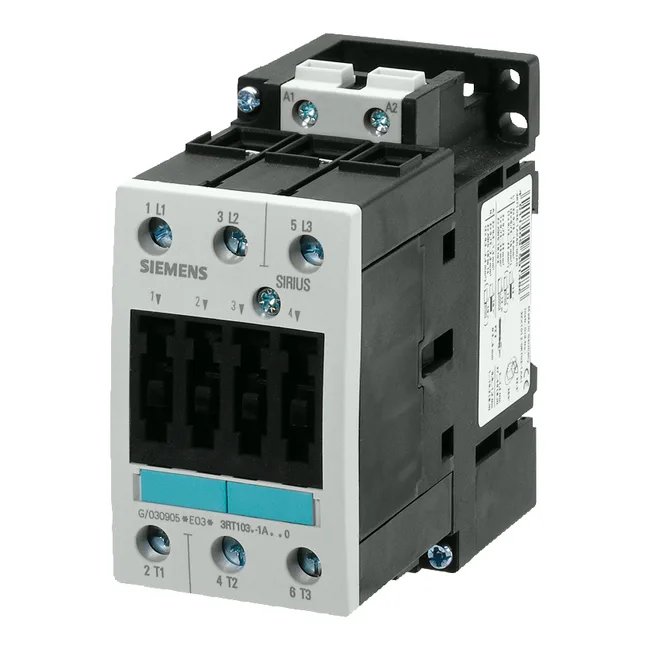
Rated for AC-2 duty at 15 kW at 400 V, this contactor handles slip-ring motor starting and reversing applications where the load current stays below the make/break rating. For higher-voltage motor circuits, it carries 18.5 kW at 500 V and 10 kW at 690 V, giving flexibility across common European and North American supply voltages.
Mechanical life is typical 10 million operations, while the maximum switching frequency varies by duty: 1200 cycles/hour at AC-1 (resistive), 1000 at AC-3 (squirrel-cage starting), 750 at AC-2, and 250 at AC-4. These numbers set the cycle budget for a given application — a conveyor with frequent starts needs the AC-3 or AC-4 rate.
Solid wire accepts 2x (0.5 to 1.5 mm²), 2x (0.75 to 2.5 mm²), and max 2x (0.75 to 4 mm²). Stranded wire handles 2x (0.75 to 25 mm²), and solid-or-stranded takes 2x (0.75 to 16 mm²). This covers most panel wiring from control to power feeds. Side-by-side mounting is permitted, which simplifies multi-contactor assemblies in tight enclosures without derating — check the thermal spacing guidelines for full load.