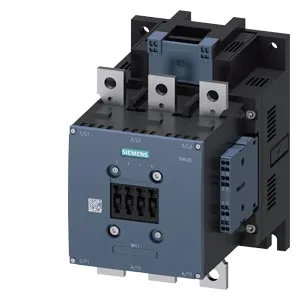
It carries a 440 to 480 VAC coil, so it is intended for 480 V line-to-line control circuits common in North American and some European installations. The contactor is screw-fixed to a mounting plate — no DIN-rail snap-on here — and the coil terminals are spring-type, which saves time on wiring when you are building a panel.
The main power lugs accept stranded cable from 70 to 240 mm² — that is heavy cable, sized for a contactor that can handle the inrush and continuous current of a large motor. The auxiliary contact block is rated 10 A at 24 V, 2 A at 48 V, and 1 A at 110 V, so it can switch PLC-level signals or small relay loads without an interposing relay, but watch the voltage-specific current limits. Switching frequency is rated per duty cycle: 750 operations per hour at AC-1 (resistive loads), 500/h at AC-3 (standard motor starting), and 130/h at AC-4 (plugging or inching). The AC-3e rating also gives 500/h. For a conveyor or pump that cycles every few seconds, the AC-3 figure governs; if you are doing reversing or jogging, the AC-4 limit is the one that keeps the contacts from overheating. That matters for coordination with upstream short-circuit protection: the arc clears fast enough that a typical motor-circuit fuse or breaker will not nuisance-trip on contactor dropout.
Dimensions: 210 mm high, 145 mm wide, 202 mm deep. Mounting is by screw fixing through a single 11 mm hole. That is tighter than some contactors — you can pack it into a smaller cabinet if you plan the layout.
The closest functional peer in the SIRIUS range is the 3RT1264-6AP36-0KA1, which shares the same Size S10 frame and coil voltage range. The main difference is the terminal design: the 3RT1264 uses cage-clamp (spring-type) terminals on the main power circuit as well, whereas the 3RT1064-2AR36 uses screw-type main lugs. If your panel is already wired with ring-tongue terminals on the power cables, the 3RT1064-2AR36 is a direct drop-in without re-terminating. If you prefer spring-clamp throughout, the 3RT1264 is the match. Either way, the mounting hole pattern and coil connections are the same.