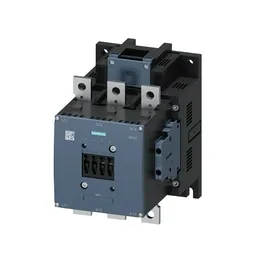
It's the big-frame member of the SIRIUS family — the one you spec when the smaller sizes run out of thermal headroom or contact gap. The coil pulls in on 200-277 V AC, which is a standard control voltage range across European and North American panel designs — no separate control transformer tap needed if your panel bus is already at 230 V or 277 V. Operate time sits at 115-130 ms on both AC and DC, with an arcing time of 10-15 ms, so it's not a fast-switching device but it's predictable for coordination studies. Mechanical life is rated at 10,000,000 cycles typical, and the MTBF is listed at 75 a — that's 75 years mean time between failures under stated conditions, which for a contactor this size means the coil and main contacts are built to outlast the panel's service life if the switching frequency stays within the duty limits.
This contactor is rated for multiple duty classes, and the switching frequency limits tell you which one governs your application. At AC-1 (resistive loads) and AC-3 (squirrel-cage motors — starting, running, stopping under load) it handles up to 500 operations per hour. At AC-2 (slip-ring motors, starting only) it's derated to 250 ops/h. At AC-4 (plugging, inching, reversing under full load) it drops to 130 ops/h. If your application is a reversing conveyor or a press that jogs frequently, the AC-4 limit is the one that matters — exceed it and the arc chutes wear fast. The auxiliary switch block is present and rated: 10 A at 24 V, 2 A at 48 V, 2 A at 60 V — all DC resistive loads. That's enough for a PLC input or a relay coil, but watch the inductive load derating if you're switching contactor coils or solenoid valves off the aux.
Mounting and wiring — panel integration
Mounting is screw fixing, not DIN rail — this is a Size S10 frame (210 mm high, 145 mm wide, 202 mm deep) that bolts to a backplate. Power-side cable termination accepts stranded conductors from 70 to 240 mm² — that's a serious cable, typically 1/0 AWG to 500 kcmil, so plan your gland plate and bend radius accordingly. The coil and auxiliary terminals are screw-type, accepting 2x (0.5-1.5 mm²) solid or 2x (0.75-2.5 mm²) stranded, with a max of 2x (0.75-4 mm²).
The contactor is rated for use in a standard industrial enclosure; no special derating needed up to 60 °C ambient, but above that you'd need to consult the thermal curve.