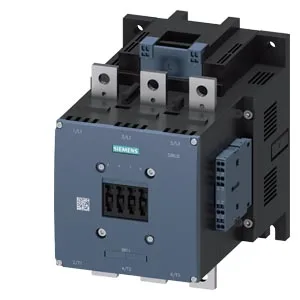
It uses a 42-48 V AC/DC coil and mounts via screw fixing to a vertical surface, with ±90° rotatability and ±22.5° tilt allowance for panel layout flexibility. Coil connections are spring-type terminals, accepting 2x (0.25 to 2.5 mm²) solid or stranded wire. The main power circuit accepts stranded cable from 70 to 240 mm², with a single 11 mm mounting hole for the power lug. The contactor carries a built-in auxiliary switch block.
Duty ratings and switching frequency
Maximum switching frequency varies by duty category: 700 operations per hour at AC-1 (resistive), 500/h at AC-3 and AC-3e (standard motor starting), 200/h at AC-2 (slip-ring motor), and 130/h at AC-4 (plugging/inching). These limits govern thermal rise in the contactor — exceeding them accelerates contact erosion, especially under AC-4 duty where the arc is struck on break under load. Arcing time is 10-15 ms; opening times for both AC and DC coils are 60-100 ms.
The integrated auxiliary switch is rated for 10 A at 24 V, 2 A at 48 V and 60 V, and 1 A at 110 V.