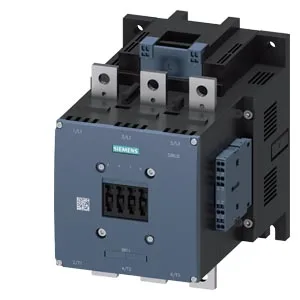
It mounts via screw fixing to a vertical surface, with ±90° rotatability and ±22.5° tilt front-to-back, giving panel builders flexibility in tight enclosures. The magnet coil is rated 440-480 V AC and terminates on spring-type terminals — no screwdriver needed for the coil connection, which speeds up wiring on a panel assembly line. The main power circuit accepts stranded conductors from 70 to 240 mm²; the auxiliary circuit takes 2x (0.25 to 2.5 mm²) solid or stranded.
Switching frequency varies by duty class: 700 operations per hour in AC-1 (resistive loads), 500/h in AC-3 and AC-3e (squirrel-cage motors, starting and running), 200/h in AC-2 (slip-ring motors), and 130/h in AC-4 (plugging, inching, reversing). The AC-3e rating aligns with the newer IEC classification for motor switching; if your application calls for AC-3e, this contactor handles it at the same 500 ops/h as standard AC-3. Auxiliary contact ratings span the control-voltage range: 10 A at 24 V, 2 A at 48 V, 2 A at 60 V, and 1 A at 110 V. These figures matter for coordinating with upstream protection and for timing sequences in a motor control center.
Environmental limits and installation clearances
The depth of 225 mm, width of 160 mm, and height of 214 mm define the envelope for panel layout. A single 11 mm mounting hole is provided for screw fixing.