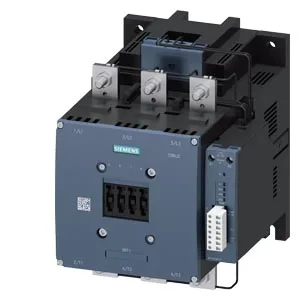
The coil voltage range is 96-127 V AC. Screw-type coil terminals simplify field wiring. The AC-1 rating (resistive load) governs continuous current capacity at 700 A — that's the number to size main power conductors and fusing. AC-3 (motor starting) and AC-4 (plugging/inching) ratings are lower; for motor duty, the AC-3 switching frequency of 500 operations per hour sets the thermal limit for repetitive starts. The arcing time of 10-15 ms is typical for this frame size and informs arc-flash coordination studies. Electrical life depends on the load; for AC-3 duty expect roughly 1-2 million cycles before contact inspection is due. The auxiliary switch is built in, rated at 10 A at 24 V, 2 A at 48-60 V, and 1 A at 110 V — enough to drive a PLC input or a small relay directly.
Mounting is screw fixing with a vertical surface orientation; the contactor can be rotated ±90° or tilted ±22.5° forward/back. That flexibility helps in tight enclosures where the busbars or cables dictate the orientation. The footprint is 214 mm high × 180 mm wide × 225 mm deep — allow 10 mm clearance above and below, 20 mm forward, and 10 mm at the sides for arc venting and airflow. Power terminals accept stranded cable from 70 mm² up to 240 mm² — that's the range for the main circuit. The auxiliary/coil terminals are screw-type, accepting 2× (0.5-1.5 mm²) solid or 2× (0.75-2.5 mm²) stranded, max 2× 4 mm². A single 11 mm diameter mounting hole is provided for the screw fix.
No end-of-life notice or last-time-buy date is available.