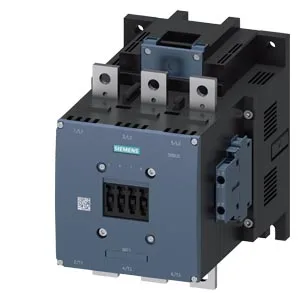
Fastening is screw fixing, not DIN-rail snap-on, so budget for mounting hardware and a drill template. Power circuit wiring takes stranded cable from 70 mm² up to 240 mm² — that's a heavy lug range, typical for the main feed on a large motor starter or a feeder contactor. Auxiliary control wiring uses screw terminals accepting 2x (0.5-1.5 mm²), 2x (0.75-2.5 mm²), or max 2x (0.75-4 mm²) solid or stranded.
Switching rates are duty-dependent: 700 operations per hour maximum in AC-1 (resistive loads), 500/h in AC-3 (standard motor starting), and 130/h in AC-4 (plugging/inching). The arcing time runs 10-15 ms, and the opening and closing times at both AC and DC are 60-100 ms. The coil's rated value is 110-127 V, with an initial pickup threshold of 0.8 times rated and a full-scale dropout of 1.1 times rated — meaning the coil will hold in down to about 88 V and will release above about 140 V. Auxiliary contact ratings: 10 A at 24 V, 2 A at 48 V, 2 A at 60 V, and 1 A at 110 V — these are the make/break capacities for the built-in auxiliary switch block, not the main power contacts. The main contactor itself has a typical mechanical life of 10 million operations.