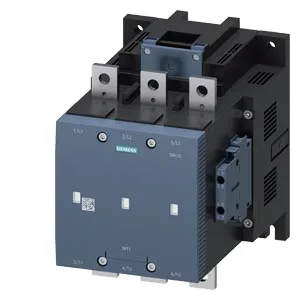
The Siemens 3RT1275-6AR36 is a SIRIUS vacuum contactor in size S12 — that's the frame size that tells you the mechanical and thermal capacity before you even look at the coil. Vacuum contacts mean the arc is quenched in a sealed chamber, so there's no contact erosion from switching air-break arcs, which makes this a solid pick for frequent switching or dusty environments where a standard contactor would wear fast. It's a screw-fixing mount, not a DIN-rail snap, so plan for panel drilling on a vertical surface; the mounting position allows ±22.5° rotation and tilt, plus standing on a horizontal surface, which gives some layout flexibility in a tight cabinet.
Rated coil voltage is 440-480 V AC, with a pickup threshold of 0.8 x rated value and a dropout at 0.9 x rated at 50/60 Hz — so at 440 V nominal, it holds in down to about 352 V and drops out around 396 V. That's a tight dropout band; if your line dips under brownout conditions, this contactor drops faster than a standard 0.7 x dropout design. Switching frequency varies by duty: AC-1 (resistive) maxes at 700 ops/h, AC-3 (squirrel-cage motor start/run) at 750 ops/h, AC-4 (plugging/inching) at 250 ops/h. The AC-3e rating also hits 750 ops/h — that's the energy-efficient motor version of the same duty. Arcing time is 10-15 ms, and operate times at both AC and DC are 60-100 ms. For a vacuum contactor, those are standard; the arc time is shorter than an air-break equivalent, which matters if you're coordinating with upstream fuses or a motor protection relay.
Termination and wiring reality
Main power terminals accept stranded cable from 70 mm² up to 240 mm² — that's serious cable, sized for the full rated current of the S12 frame. The coil connection is screw-type terminals, accepting solid or stranded wire: 2x 0.5-1.5 mm², 2x 0.75-2.5 mm², max 2x 0.75-4 mm². Auxiliary switch is included, so you don't need to order a separate side-mount block for feedback to the PLC. The auxiliary contacts are rated at 10 A at 24 V, 2 A at 48 V, 2 A at 60 V, and 1 A at 110 V — typical for a signal-level contact, not for driving a load directly.