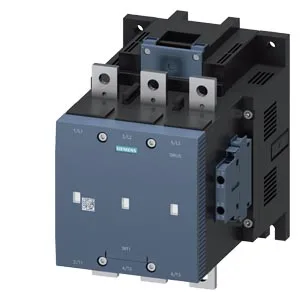
The vacuum arc-quenching chamber handles frequent switching without contact erosion, making it suited for applications like conveyors, pumps, and compressors that cycle heavily. The coil is rated for 220-240 V AC/DC, with a pick-up threshold of 0.8x rated value and a drop-out at 1.1x full-scale value, meaning it holds in reliably across a sag to about 176 V and releases cleanly above 264 V. Mechanical life is rated at 10,000,000 operations typical, and the contactor can sustain operating rates up to 750 cycles per hour in AC-3 duty (motor starting) and 250 cycles per hour in AC-4 (plugging/reversing).
Auxiliary contact ratings: 10 A at 24 V, 2 A at 48 V, 2 A at 60 V, and 1 A at 110 V. These are the make/break capacities for the control circuit — a 24 V PLC output driving a relay or a 110 V interlock both fall within range, but the 110 V limit means you cannot switch a 2 A 110 V load on this auxiliary contact. Power wiring accepts stranded conductors from 70 to 240 mm², while the coil and auxiliary wiring accept solid or stranded from 0.5 to 4 mm². That covers main motor feeders up to about 300 A and control wiring down to 20 AWG. Mounting is by screw fixing with one 11 mm hole. That flexibility helps when retrofitting into existing enclosures where the backplate is already drilled.
Dimensions and clearances
The contactor measures 214 mm high, 160 mm wide, and 225 mm deep. These clearances ensure adequate air circulation and arc-quenching space — a panel builder should account for them when laying out the gland plate and busbar runs.