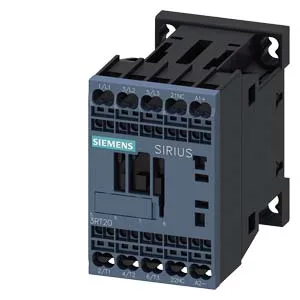
The 24 VDC coil pulls in at its rated value and the main contacts are rated for 10 A at 24 V DC-13 (switching electromagnets), with a DC-13 breaking capacity that drops as voltage rises — 2 A at 48 V and 60 V, 1 A at 110 V, 0.3 A at 220 V, and 3 A at 400 V. Spring-type terminals (cage clamp style) accept 0.5 to 4 mm² solid or stranded wire, and you can double up two conductors of the same cross-section per clamp.
The Size S00 footprint is 45 mm wide, 70 mm tall, 73 mm deep — tight enough for crowded subpanels. Mounting position is flexible: you can rotate the contactor ±180° on a vertical surface or tilt it ±22.5° forward/backward. Clearance requirements are modest — 10 mm upward, downward, and forward, 6 mm to the side. The arcing time is 10 to 15 ms, and dropout time at DC is 38 to 65 ms, which matters when sequencing contactors in a safety circuit.
The DC-13 rating is the one that governs real use: 10 A at 24 V means it can switch the inductive load of a medium-sized DC solenoid or brake, but if you're switching a resistive DC heater, the AC-1 rating (not explicitly listed here but implied by the contactor class) would be higher. The operating temperature range is -25 to +60 °C, storage -55 to +80 °C — fine for most indoor panels but watch the upper end near ovens or sunny enclosures. Mechanical life is typical 30 million operations; electrical life depends on the load and switching frequency — at AC-3 (motor) duty it's rated for 750 cycles per hour maximum, at AC-4 (inching/plugging) it drops to 250 cycles per hour. The auxiliary switch is not built in (listed as 'No'), so if you need a mirror contact or status feedback, you'll need to add a separate auxiliary contact block.