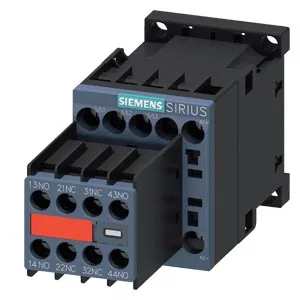
The coil is rated at 24 VDC, with a pickup (initial) value of 0.8 x rated value and a dropout range of 38 to 65 ms DC. This means the coil will reliably pull in at 19.2 VDC and hold, but the dropout timing is loose enough that you need to verify it against your control logic's timing requirements. Main contact switching capacity at DC voltages: 6 A at 24 V, 2 A at 48 V and 60 V, 1 A at 110 V, 0.9 A at 125 V, 0.3 A at 220 V, and 3 A at 400 V. These are the current limits per pole for DC loads; for AC motor duty, the contactor is rated for 2 hp at 230 V. Maximum switching frequency varies by duty class: 1,000 cycles/hour for AC-1 (resistive), 750 cycles/hour for AC-2 and AC-3 (motor starting/running), and 250 cycles/hour for AC-4 (plugging/inching). The AC-3e rating also caps at 750 cycles/hour.
Wiring and environmental limits
For two conductors per terminal, the range is 2x (0.5 to 1.5 mm²), 2x (0.75 to 2.5 mm²), or 2x 4 mm². This covers common control wiring sizes, but if you're paralleling fine wires, check the ferrule compatibility. The contactor carries no auxiliary switch, so any feedback or status indication must come from an external block.
No successor order code is listed, so the 3RT2018-1FB44-3MA0 is the direct procurement target for new designs and MRO spares.