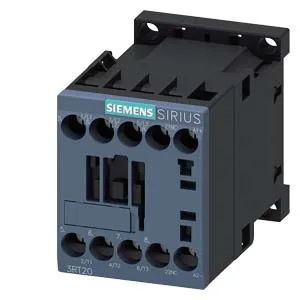
The coil is rated 24 VDC. That's the nominal pull-in voltage; the dropout band sits at 7 to 13 ms, which matters if you're coordinating with a PLC output that needs to drop the contactor quickly on a safety stop. Main contact ratings are given per duty. At 230 V it handles 2 hp; at 400 V the current rating is 3 A. For DC switching, the auxiliary contacts break 10 A at 24 V, 2 A at 48 V, 2 A at 60 V, 1 A at 110 V, 0.9 A at 125 V, and 0.3 A at 220 V. So the DC curve drops fast above 60 V — if you're switching a 125 VDC solenoid bank, you're limited to 0.9 A per contact. Mechanical life is typical at 30,000,000 operations. The maximum switching frequency varies by duty: 1,000 1/h under AC-1 (resistive), 750 1/h under AC-2 and AC-3 (motor start/run), and 250 1/h under AC-4 (plugging/inching). AC-3e also maxes at 750 1/h. If your application cycles a conveyor motor at 500 starts per hour, the AC-3 rating has headroom.
The contactor measures 45 mm wide, 58 mm high, and 73 mm deep. For multiple conductors, it takes 2x (0.5 to 1.5 mm²), 2x (0.75 to 2.5 mm²), or 2x 4 mm². That covers most control-circuit wiring gauges you'd run in a panel.