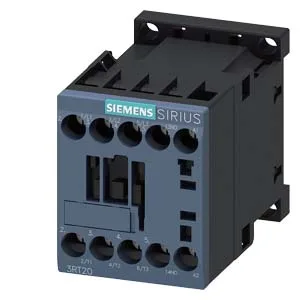
The 3RT2018-1AB01-ZX95: The contactor carries auxiliary contacts rated at specific currents per voltage: 10 A at 24 V, 2 A at 48 V and 60 V, 1 A at 110 V, 0.9 A at 125 V, 0.3 A at 220 V, 3 A at 400 V, and 0.2 A at 440 V. These ratings tell you the maximum current the auxiliary circuit can break at each voltage — important when feeding PLC inputs or relay coils. Switching frequency limits vary by duty class: 1,000 cycles/hour for AC-1 resistive loads, 750 cycles/hour for AC-2 and AC-3 motor starting, and 250 cycles/hour for AC-4 plugging/inching duty. These numbers govern how often you can cycle the contactor in a given application — exceed them and the contacts overheat. For a conveyor running AC-3 starts, 750 cycles/hour is the ceiling. The contactor can live in a warm panel or a cold warehouse, but the 60 °C operating limit means you need to check ambient inside the enclosure if it's near a heat source like a drive.
Wiring and mounting details
Screw-type terminals on the magnet coil and main contacts accept solid or stranded wire from 0.5 to 4 mm², with multi-wire options: 2x (0.5 to 1.5 mm²), 2x (0.75 to 2.5 mm²), or 2x 4 mm². Strip length and torque values are standard for this class — no special tools needed beyond a screwdriver. These are minimum air gaps to adjacent metalwork or other devices — ignoring them risks flashover or reduced cooling.