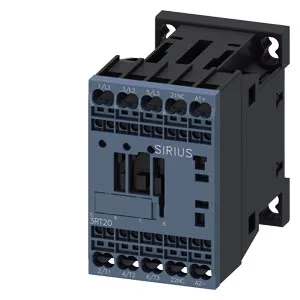
It is rated for a main contact operational current of 12 A, with the coil drawing 24 V DC. The contactor uses spring-type terminals for the magnet coil connection, and its auxiliary switch is integrated.
The 12 A main contact rating (at AC-3 duty, typical for motor switching) tells you this contactor can handle a 3-phase motor up to roughly 5.5 kW at 400 V — a common size for small pumps, fans, or conveyors. The auxiliary contact ratings span from 10 A at 24 V DC down to 0.3 A at 220 V DC, so it can switch control signals or small DC loads in the same panel. The mechanical switching frequency is rated up to 1000 operations per hour at AC-1 (resistive), 750 at AC-2 and AC-3 (motor starting/running), and 250 at AC-4 (plugging/inching). For high-duty-cycle applications like indexing conveyors, the AC-4 limit is the one to watch — it governs how often you can reverse or jog the motor without overheating the contacts.
This contactor class is used in industrial control panels for switching motors, heaters, and other loads under the control of a PLC or manual switch. The size S00 frame is typical for small to medium motor starters in machinery, conveyors, and HVAC equipment. The spring-type terminals speed up wiring — no screwdriver needed for the coil connection, which is a time-saver on repetitive panel builds.