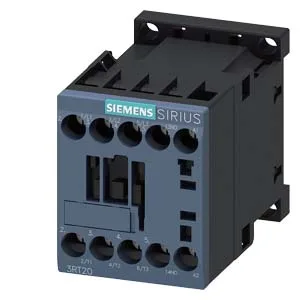
The coil is rated 24 VDC, and the main contacts are rated for switching at various DC voltage levels: 10 A at 24 V, 2 A at 48 V and 60 V, 1 A at 110 V, 0.9 A at 125 V, 0.3 A at 220 V, and 3 A at 400 V. This means the contactor can handle DC loads across a range of control voltages, but the current capability drops significantly as voltage rises — a key consideration for DC load switching where arc extinction is harder than AC. Switching frequency varies by duty class: up to 1,000 operations per hour at AC-1 (resistive loads), 750 ops/h at AC-2 and AC-3 (motor starting/running), and 250 ops/h at AC-4 (plugging/inching). The AC-3e rating also allows 750 ops/h. These limits govern how aggressively you can cycle the contactor in a given application — exceeding them shortens mechanical life.
That saves time on a panel build and avoids loose-terminal callbacks. This flexibility helps when fitting into tight or oddly oriented enclosures.
The storage range is wider — that covers shipping and warehouse conditions, not running duty. For a solar farm or desert installation, the 60 °C operating ceiling is adequate but leaves no headroom for internal cabinet heating above ambient; derate if the panel runs hot.