What it is and what it fits
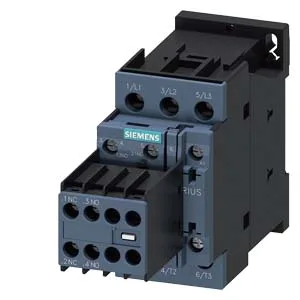
The Siemens 3RT2024-1AC24 is a SIRIUS power contactor in the S0 frame size, built for switching motor and resistive loads in control panels. It lands on a 35 mm DIN rail per EN 60715 — screw and snap-on mounting, so it clips in without a backplate. The 45 mm width and 85 mm height mean it slots into a standard S0 footprint; the 141 mm depth is the body plus terminals, so plan gland plate clearance accordingly.
Ratings that drive the buy decision
Coil is 24 VDC, screw-type terminals — no auxiliary switch built in, so if you need a feedback contact for the PLC, budget for a separate auxiliary contact block. The main contact rating at AC-3 (motor duty) hits 1000 operations per hour, which is standard for a general-purpose S0 contactor; AC-4 (inching/jogging) drops to 300 1/h because the arc stress on the contacts is heavier. Mechanical life is typical 10 million operations — that's the no-load figure; actual electrical life depends on the load current and switching frequency. Wire range: solid or stranded 1 to 10 mm², and it also accepts 2x (0.5 to 1.5 mm²) or 2x (0.75 to 2.5 mm²) for daisy-chaining. That covers most panel wiring up to 10 AWG. The arcing time is 10 ms, and the AC switching time is 4 to 16 ms — fast enough for standard motor starts, but if you're coordinating with a soft starter or VFD output, check the contactor's make/break timing against the drive's pre-charge circuit. Clearance requirements: 10 mm upwards, 10 mm forwards, 10 mm downwards, and 6 mm at the side. That's the minimum air gap for arc flash and heat dissipation — tighter than some older designs, so a panel built for a different S0 contactor may need a quick check before dropping this one in.
Where it goes in the panel
Mounting position is flexible: +/-180° rotation on a vertical surface, and can be tilted forward/backward by +/-22.5° on a vertical surface. That helps when the panel layout is tight and the rail is at an odd angle. Storage temperature range is -55 to +80 °C; operating range is -25 to +60 °C — fine for most indoor industrial environments, but if the panel sits in a non-conditioned space that sees freezing, the coil hold-in at low temperature is something to verify.
